Size & measurements
No sourced size & measurements summary has yet been added to this account.
Colubridae · Species account
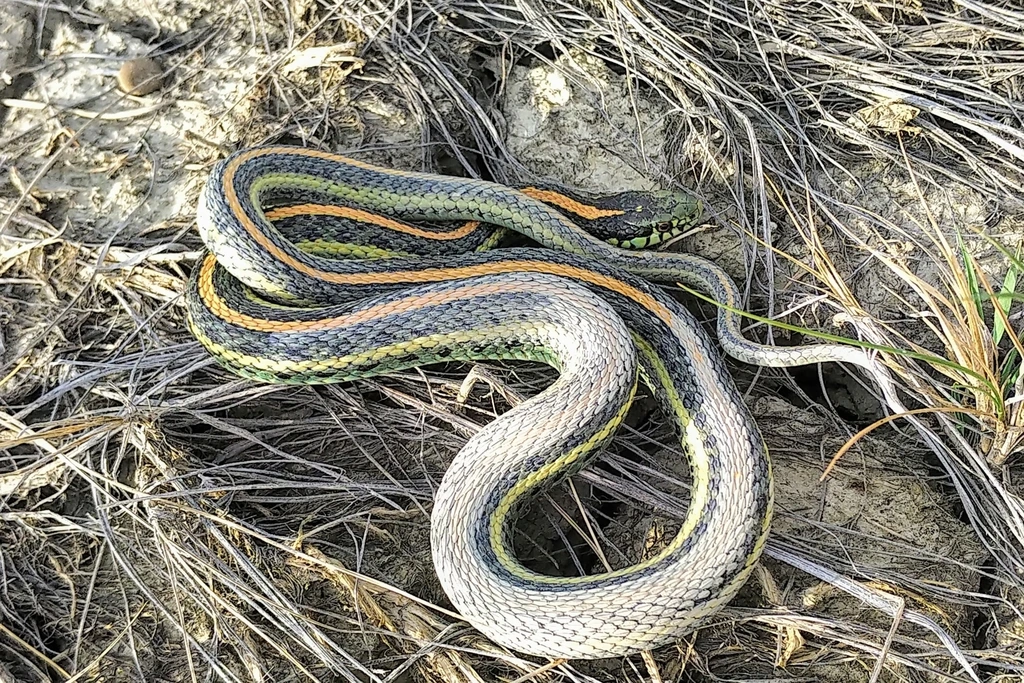
Thamnophis radix(BAIRD & GIRARD, 1853)
VenomousClinical severity not establishedPrairie and meadow habitat is commonly associated with ponds, streams or marshes. River margins and some urban open ground are also used. Source scope: Animal Diversity Web species account; habitat use is not a state or province occurrence record.
Venom & human effects
A 2025 study describes venom-related gland gene expression in sampled individuals of this species. This is molecular evidence; it does not establish the effects of a bite on humans.
Study samples from Illinois, USA. Gene expression does not by itself measure venom potency or clinical severity.
Heptinstall et al. (2025), Materials and methods: DVG transcriptomics; Results, Fig.2; Discussion: DVG transcriptomics; Conclusion; Supplementary Material1 sample metadata. Sample IDs: Tradi-CLP2870.
These are editorial summaries of the linked evidence, not toxicity rankings or WHO antivenom-priority categories. Effects vary with the bite and patient. Non-venomous does not mean safe to handle.
The scientific identity
Reliable identification uses the published combination of scale characters, proportions and other diagnostic evidence. Colour or a photograph alone may not separate closely related species.
From observations & literature
No sourced size & measurements summary has yet been added to this account.
The University of Nebraska account lists amphibians, fish, worms and slugs as prey.
Regional university species account. Seasonal dates describe the Nebraska guide’s context; prey lists do not imply exclusive diets or equal feeding frequencies.
University of Nebraska–Lincoln, Amphibians, Turtles & Reptiles of Nebraska, Thamnophis radix; Habitat, Diet & Range > Diet.
Published feeding records in the cited compilation include earthworms, fish, frogs, leeches, mammals, slugs, snakes, and tadpoles.
Compiled field records from different populations; this list does not establish prey preference or feeding frequency.
Heptinstall et al. (2024), Dietary Record Collection and public GloBI dataset, exact species rows. Representative original references by prey group: earthworms: Schield and Waye 2012 (CSV line 325); fish: Marr 1944 (CSV line 329); frogs: Tye and Galuso 2019 (CSV line 327); leeches: Hart 1975 (CSV line 335); mammals: Marr 1944 (CSV line 328); slugs: Hart 1975 (CSV line 338); snakes: Vecchiet and Schramer 2018 (CSV line 326); tadpoles: Hart 1975 (CSV line 330).
The University of Nebraska account describes mainly daytime activity, with nighttime activity reported rarely and a regional active season from March to October.
Regional university species account. Seasonal dates describe the Nebraska guide’s context; prey lists do not imply exclusive diets or equal feeding frequencies.
University of Nebraska–Lincoln, Amphibians, Turtles & Reptiles of Nebraska, Thamnophis radix; Life History.
Live-bearing.
Prairie and meadow habitat is commonly associated with ponds, streams or marshes. River margins and some urban open ground are also used. Source scope: Animal Diversity Web species account; habitat use is not a state or province occurrence record.
[2]The treatment names these subdivisions in its Canada distribution clause: Manitoba, Saskatchewan, Alberta. They are assigned to the declared atlas navigation groups; this is not a field observation, a whole-region range polygon or a complete local inventory.
[3]The treatment names these subdivisions in its United States of America distribution clause: Oklahoma, Nebraska, New Mexico, South Dakota, Texas, Missouri, Colorado, Wyoming, Kansas, Illinois, Montana, Iowa, Wisconsin, North Dakota, Arkansas, Indiana, Minnesota. They are assigned to the declared atlas navigation groups; this is not a field observation, a whole-region range polygon or a complete local inventory.
[4]A reported observation is not necessarily the full ecological range of a species. Where reproduction is inferred in a source dataset, the account identifies that limitation.
One species · Across borders
Explore the recorded countries and islands. Select a highlighted area to see its distribution evidence.
Loading geographic boundaries…
Click a highlighted country to zoom in and explore its records.
Shading identifies recorded countries or named islands, not continuous habitat coverage. Uncoloured areas do not establish absence.
Natural Earth · 1:50m · public domain; Gibraltar: geoBoundaries. Small islands may lack an outline.
Explore the distribution
Select a highlighted area to see its status, island records and sources. Each country and island links to the same shared species collection.
Use “Worldwide records” to include distant introduced and uncertain records in the map view.
The checked taxonomic distribution account explicitly lists Canada. Country-level evidence does not establish continuous occupancy or a complete national inventory. The treatment names these subdivisions in its Canada distribution clause: Manitoba, Saskatchewan, Alberta. They are assigned to the declared atlas navigation groups; this is not a field observation, a whole-region range polygon or a complete local inventory.
Manitoba → · Manitoba
Saskatchewan → · Saskatchewan
Alberta → · Alberta
Locality source 1 ↗The checked taxonomic distribution account explicitly lists United States of America. Country-level evidence does not establish continuous occupancy or a complete national inventory. The treatment names these subdivisions in its United States of America distribution clause: Oklahoma, Nebraska, New Mexico, South Dakota, Texas, Missouri, Colorado, Wyoming, Kansas, Illinois, Montana, Iowa, Wisconsin, North Dakota, Arkansas, Indiana, Minnesota. They are assigned to the declared atlas navigation groups; this is not a field observation, a whole-region range polygon or a complete local inventory.
Oklahoma → · Oklahoma
Nebraska → · Nebraska
New Mexico → · New Mexico
South Dakota → · South Dakota
Texas → · Texas
Missouri → · Missouri
Colorado → · Colorado
Wyoming → · Wyoming
Kansas → · Kansas
Illinois → · Illinois
Montana → · Montana
Iowa → · Iowa
Wisconsin → · Wisconsin
North Dakota → · North Dakota
Arkansas → · Arkansas
Indiana → · Indiana
Minnesota → · Minnesota
Locality source 1 ↗Country entries supported by this Americas review: Canada, United States of America. These are reviewed atlas entries, not a complete global distribution. [1]
The text retains the source’s geographic qualifications. The map shows countries with atlas occurrence records; it is not a complete global range model. A type locality is a nomenclatural reference, not the only place the species occurs.
Status & its meaning
No matching global assessment was verified for this account. This is an unresolved assessment link, not an IUCN “Not Evaluated” classification and not evidence that the species is secure.
Locality coverage in the atlas does not measure abundance, population trends or national legal protection.
Follow the evidence
Latest evidence added 2026-10-16. Taxonomic and distribution treatments may change.
The linked taxonomic treatment provides its original descriptions, revisions and bibliography. Observations from other countries are not relabelled as local field studies.