Size & measurements
No sourced size & measurements summary has yet been added to this account.
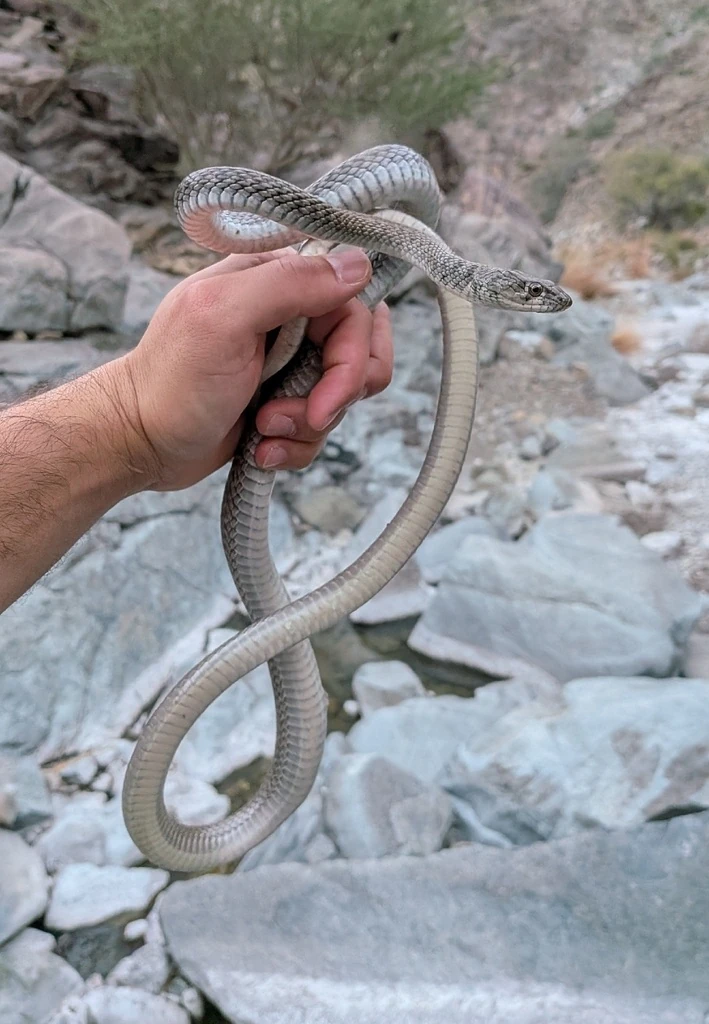
Colubridae · Species account
Platyceps rhodorachis(JAN, 1863)
Venom unknownNot yet assessedIndia is explicitly listed in the checked individual taxonomic treatment. The national ZSI checklist independently lists Platyceps rhodorachis. Regional evidence: Jammu and Kashmir. Named records do not imply continuous occurrence throughout a region. This older summary is superseded by the reviewed distribution account above. Use that account for the current country status and regional scope.
Venom & human effects
Venom status has not yet been established from the reviewed evidence for this account.
Missing evidence is not a non-venomous classification or a statement of low risk.
These are editorial summaries of the linked evidence, not toxicity rankings or WHO antivenom-priority categories. Effects vary with the bite and patient. Non-venomous does not mean safe to handle.
The scientific identity
Reliable identification uses the published combination of scale characters, proportions and other diagnostic evidence. Colour or a photograph alone may not separate closely related species.
Taxonomic treatment & original-description references ↗
Etairejus rhodorachis · Zamenis rhodorachis · Coluber florulentus · Zamenis ventromaculatus · Platyceps semifasciatus · Compsosoma semifasciata · Gonyosoma dorsale · Zamenis ventrimaculatus · Zamenis rhodorhachis · Coluber rhodorachis · Coluber rhodorhachis · Coluber r · Coluber insulanus · Coluber rhodorhachus · Haemorrhois rhodorhachis · Eremiophis rhodorhachis · Platyceps rhodorachus · Platyceps tessellata · Platyceps insulanus · Platyceps rhodorhachis · Zamenis ladacensis · Platyceps subnigra
Names trace the literature, including older combinations and historical usages. Their appearance here does not mean they are all currently accepted synonyms.
From observations & literature
No sourced size & measurements summary has yet been added to this account.
No sourced diet & feeding summary has yet been added to this account.
No sourced activity & behaviour summary has yet been added to this account.
No sourced habitat & ecology summary has yet been added to this account.
India is explicitly listed in the checked individual taxonomic treatment. The national ZSI checklist independently lists Platyceps rhodorachis. Regional evidence: Jammu and Kashmir. Named records do not imply continuous occurrence throughout a region. This older summary is superseded by the reviewed distribution account above. Use that account for the current country status and regional scope.
[1][2][28]China is explicitly recorded in the checked individual species treatment. The accepted identity is also represented in the 2025 checklist; regional inclusion here is based on explicit locality evidence, not the checklist’s broader geographical scope. This older summary is superseded by the reviewed distribution account above. Use that account for the current country status and regional scope.
[3][4][28]The 2025 field-study Table 1 records a juvenile in Kabul on 30 March 2012 at 1,861 m (photographic voucher CUHC-PA 157). This older summary is superseded by the reviewed distribution account above. Use that account for the current country status and regional scope.
[3][5][6][28]Pakistan is explicitly recorded in the checked individual species treatment.
[3]The 2025 field-study Table 1 records a juvenile in Kabul on 30 March 2012 at 1,861 m (photographic voucher CUHC-PA 157). This older summary is superseded by the reviewed distribution account above. Use that account for the current country status and regional scope.
[9][10][11][28]Turaif survey, 2014–2015; reported under the publication’s historical nomenclature. Historical localities cited in the Turaif paper; not whole-region occupancy.
[12]Fujairah & eastern coast: observation GBIF 6251573547 (2026). The original iNaturalist entry was rechecked for research-grade identification, wild status and unrestricted coordinates; its reported uncertainty footprint lies within the mapped region. This is a community-reviewed observation, not a museum voucher. Fujairah & eastern coast: observation GBIF 6179300143 (2026). The original iNaturalist entry was rechecked for research-grade identification, wild status and unrestricted coordinates; its reported uncertainty footprint lies within the mapped region. This is a community-reviewed observation, not a museum voucher. Northern emirates: observation GBIF 5760223618 (2025). The original iNaturalist entry was rechecked for research-grade identification, wild status and unrestricted coordinates; its reported uncertainty footprint lies within the mapped region. This is a community-reviewed observation, not a museum voucher. Northern emirates: observation GBIF 5935159552 (2025). The original iNaturalist entry was rechecked for research-grade identification, wild status and unrestricted coordinates; its reported uncertainty footprint lies within the mapped region. This is a community-reviewed observation, not a museum voucher. Dubai: observation GBIF 6178587709 (2025). The original iNaturalist entry was rechecked for research-grade identification, wild status and unrestricted coordinates; its reported uncertainty footprint lies within the mapped region. This is a community-reviewed observation, not a museum voucher. These are dated locality records, not evidence of occurrence throughout every part of a region or a complete present-day inventory.
[13][14][15][16][17][18][19][20][21][22]Ali Sabieh: observation GBIF 5087138013 (2025). The original iNaturalist entry was rechecked for research-grade identification, wild status and unrestricted coordinates; its reported uncertainty footprint lies within the mapped region. This is a community-reviewed observation, not a museum voucher. These are dated locality records, not evidence of occurrence throughout every part of a region or a complete present-day inventory.
[23][24]A reported observation is not necessarily the full ecological range of a species. Where reproduction is inferred in a source dataset, the account identifies that limitation.
One species · Across borders
Explore the recorded countries and islands. Select a highlighted area to see its distribution evidence.
Loading geographic boundaries…
Click a highlighted country to zoom in and explore its records.
Shading identifies recorded countries or named islands, not continuous habitat coverage. Uncoloured areas do not establish absence.
Natural Earth · 1:50m · public domain; Gibraltar: geoBoundaries. Small islands may lack an outline.
Explore the distribution
Select a highlighted area to see its status, island records and sources. Each country and island links to the same shared species collection.
Use “Worldwide records” to include distant introduced and uncertain records in the map view.
The individual treatment explicitly lists Djibouti. No within-country region or coordinate is inferred from this country-level record. The current taxonomic treatment explicitly lists this country. This is country-scale checklist evidence, not a claim of continuous occupancy or a complete regional inventory. Ali Sabieh: observation GBIF 5087138013 (2025). The original iNaturalist entry was rechecked for research-grade identification, wild status and unrestricted coordinates; its reported uncertainty footprint lies within the mapped region. This is a community-reviewed observation, not a museum voucher. These are dated locality records, not evidence of occurrence throughout every part of a region or a complete present-day inventory.
Ali Sabieh → · Ali Sabieh
Locality source 1 ↗ Locality source 2 ↗ Locality source 3 ↗Explicit country record in the checked taxonomic treatment.
Locality source 1 ↗Explicit country record in the checked taxonomic treatment.
Locality source 1 ↗Explicit country record in the checked taxonomic treatment.
Locality source 1 ↗Pakistan is explicitly recorded in the checked individual species treatment.
Locality source 1 ↗Explicit country record in the checked taxonomic treatment. Turaif survey, 2014–2015; reported under the publication’s historical nomenclature. Historical localities cited in the Turaif paper; not whole-region occupancy.
Northern deserts → · Turaif, Northern Borders
Central plateau → · Riyadh, Al-Dirriyah
Western mountains & coast → · Buryman, Jeddah
Southwestern highlands → · Abha
Locality source 1 ↗ Locality source 2 ↗The individual treatment explicitly lists Somalia. No within-country region or coordinate is inferred from this country-level record. The current taxonomic treatment explicitly lists this country. This is country-scale checklist evidence, not a claim of continuous occupancy or a complete regional inventory. The country-scale source may cover a wider area than the separately labelled Somalia outline in this geographic atlas; regional placements require their own localities.
Locality source 1 ↗Explicit country record in the checked taxonomic treatment.
Locality source 1 ↗Explicit country record in the checked taxonomic treatment.
Locality source 1 ↗Explicit country record in the checked taxonomic treatment. Fujairah & eastern coast: observation GBIF 6251573547 (2026). The original iNaturalist entry was rechecked for research-grade identification, wild status and unrestricted coordinates; its reported uncertainty footprint lies within the mapped region. This is a community-reviewed observation, not a museum voucher. Fujairah & eastern coast: observation GBIF 6179300143 (2026). The original iNaturalist entry was rechecked for research-grade identification, wild status and unrestricted coordinates; its reported uncertainty footprint lies within the mapped region. This is a community-reviewed observation, not a museum voucher. Northern emirates: observation GBIF 5760223618 (2025). The original iNaturalist entry was rechecked for research-grade identification, wild status and unrestricted coordinates; its reported uncertainty footprint lies within the mapped region. This is a community-reviewed observation, not a museum voucher. Northern emirates: observation GBIF 5935159552 (2025). The original iNaturalist entry was rechecked for research-grade identification, wild status and unrestricted coordinates; its reported uncertainty footprint lies within the mapped region. This is a community-reviewed observation, not a museum voucher. Dubai: observation GBIF 6178587709 (2025). The original iNaturalist entry was rechecked for research-grade identification, wild status and unrestricted coordinates; its reported uncertainty footprint lies within the mapped region. This is a community-reviewed observation, not a museum voucher. These are dated locality records, not evidence of occurrence throughout every part of a region or a complete present-day inventory.
Fujairah & eastern coast → · Fujairah
Northern emirates → · Ras al-Khaimah
Dubai → · Dubai
Locality source 1 ↗ Locality source 2 ↗ Locality source 3 ↗ Locality source 4 ↗ Locality source 5 ↗ Locality source 6 ↗ Locality source 7 ↗ Locality source 8 ↗ Locality source 9 ↗ Locality source 10 ↗ Locality source 11 ↗Explicit country record in the checked taxonomic treatment.
Locality source 1 ↗The 2026 study confirms populations from the Horn of Africa through Arabia to southern Iran, Pakistan and Türkiye. Putative Central Asian specimens belonged to different lineages; the Afghan Kandahar sample remains unnamed. Older Afghan photographic and northern Asian checklist records need reassessment under this narrower species concept. [28]
The text retains the source’s geographic qualifications. The map shows countries with atlas occurrence records; it is not a complete global range model. A type locality is a nomenclatural reference, not the only place the species occurs.
Status & its meaning
No matching global assessment was verified for this account. This is an unresolved assessment link, not an IUCN “Not Evaluated” classification and not evidence that the species is secure.
Locality coverage in the atlas does not measure abundance, population trends or national legal protection.
Follow the evidence
Latest evidence added 2026-10-12. Taxonomic and distribution treatments may change.
The linked taxonomic treatment provides its original descriptions, revisions and bibliography. Observations from other countries are not relabelled as local field studies.