Size & measurements
No sourced size & measurements summary has yet been added to this account.
Elapidae · Species account
Hoplocephalus bungaroides(SCHLEGEL, 1837)
VenomousClinical severity not establishedThe taxonomic treatment records partly arboreal.
Venom & human effects
The species account explicitly identifies this snake as venomous. Human medical effects have not yet been assessed for this atlas.
Exact-species statement in the retained Reptile Database treatment; this review establishes venom presence only, not human bite severity.
Comment field: Venomous.
These are editorial summaries of the linked evidence, not toxicity rankings or WHO antivenom-priority categories. Effects vary with the bite and patient. Non-venomous does not mean safe to handle.
The scientific identity
Reliable identification uses the published combination of scale characters, proportions and other diagnostic evidence. Colour or a photograph alone may not separate closely related species.
Taxonomic treatment & original-description references ↗
Naja bungaroides · Alecto variegata
Names trace the literature, including older combinations and historical usages. Their appearance here does not mean they are all currently accepted synonyms.
From observations & literature
No sourced size & measurements summary has yet been added to this account.
Published records compiled in SquamBase report 2–20 young per litter. These are the smallest and largest reported broods in the compilation, not a typical brood size or a complete limit for the species.
Exact-name row in the 2024 literature compilation. These are records from studied populations, not typical values, an exhaustive biological account, or evidence of occurrence in every region.
SquamBase 1.0, Supplementary Table S1, row 9306: Hoplocephalus bungaroides; columns Mode of reproduction, Mode of reproduction metadata, smallest brood, largest brood, brood size metadata.
The official ecological account includes open forest, woodland. These are species-level habitat records, not a statement that every state locality contains all these environments.
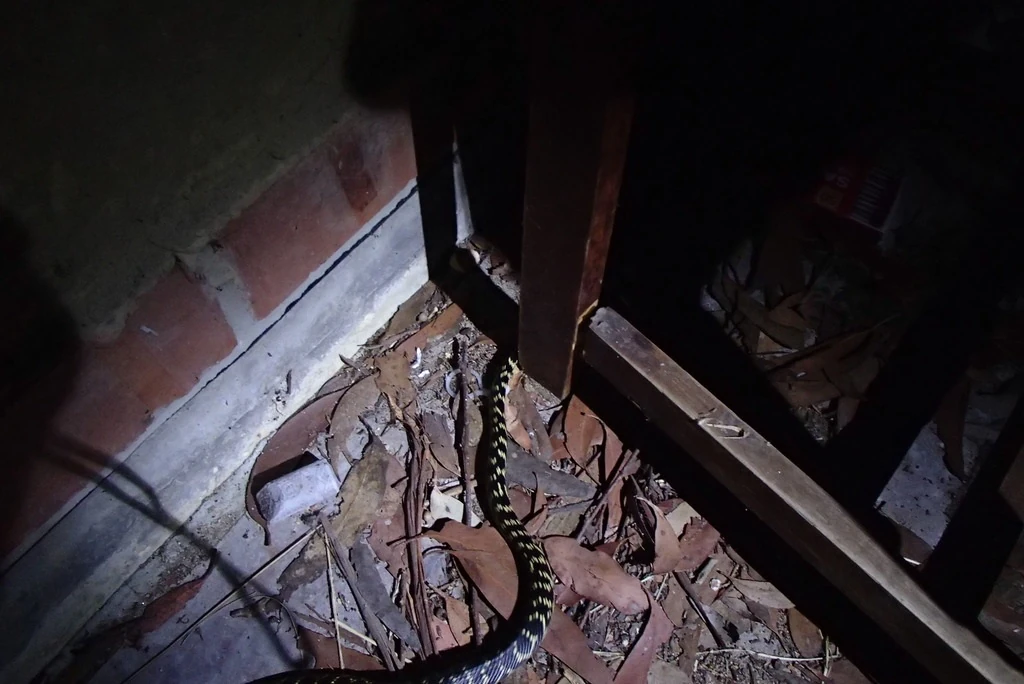
[3]In the sandstone country around Sydney, autumn-to-spring refuges include rock fissures and flat rocks on exposed escarpments. During summer snakes move into crevices or hollows of large trees near those escarpments. Conserving the woodland and its mature hollow trees therefore matters alongside retaining the rock shelters.
[4]Australia is listed in the individual taxonomic treatment and the ASH national checklist. Named state/territory evidence: New South Wales. These are documented jurisdictions, not continuous range polygons.
[1][2][3]The adopted November 2025 conservation action plan identifies protected habitat areas in these five reserves and prescribes population-occupancy monitoring. These are reserve-scale conservation localities, not a claim that all habitat throughout each park is occupied.
[5]A reported observation is not necessarily the full ecological range of a species. Where reproduction is inferred in a source dataset, the account identifies that limitation.
One species · Across borders
Explore the recorded countries and islands. Select a highlighted area to see its distribution evidence.
Loading geographic boundaries…
Click a highlighted country to zoom in and explore its records.
Shading identifies recorded countries or named islands, not continuous habitat coverage. Uncoloured areas do not establish absence.
Natural Earth · 1:50m · public domain; Gibraltar: geoBoundaries. Small islands may lack an outline.
Explore the distribution
Select a highlighted area to see its status, island records and sources. Each country and island links to the same shared species collection.
Use “Worldwide records” to include distant introduced and uncertain records in the map view.
Australia is listed in the individual taxonomic treatment and the ASH national checklist. Named state/territory evidence: New South Wales. These are documented jurisdictions, not continuous range polygons. The adopted November 2025 conservation action plan identifies protected habitat areas in these five reserves and prescribes population-occupancy monitoring. These are reserve-scale conservation localities, not a claim that all habitat throughout each park is occupied.
New South Wales → · New South Wales, Blue Mountains National Park, Dharawal National Park, Morton National Park, Royal National Park, Upper Nepean State Conservation Area
Locality source 1 ↗ Locality source 2 ↗ Locality source 3 ↗ Locality source 4 ↗The checked taxonomic treatment lists Australia (New South Wales). [1]
The text retains the source’s geographic qualifications. The map shows countries with atlas occurrence records; it is not a complete global range model. A type locality is a nomenclatural reference, not the only place the species occurs.
Status & its meaning
No matching global assessment was verified for this account. This is an unresolved assessment link, not an IUCN “Not Evaluated” classification and not evidence that the species is secure.
Locality coverage in the atlas does not measure abundance, population trends or national legal protection.
Follow the evidence
Latest evidence added 2026-10-11. Taxonomic and distribution treatments may change.
The linked taxonomic treatment provides its original descriptions, revisions and bibliography. Observations from other countries are not relabelled as local field studies.