Size & measurements
Recorded size
SquamBase 1.0 records a literature maximum of 120.5 cm total length, including the tail. This is a compiled maximum, not a typical adult size or a measurement specific to this country.
[2]Colubridae · Species account
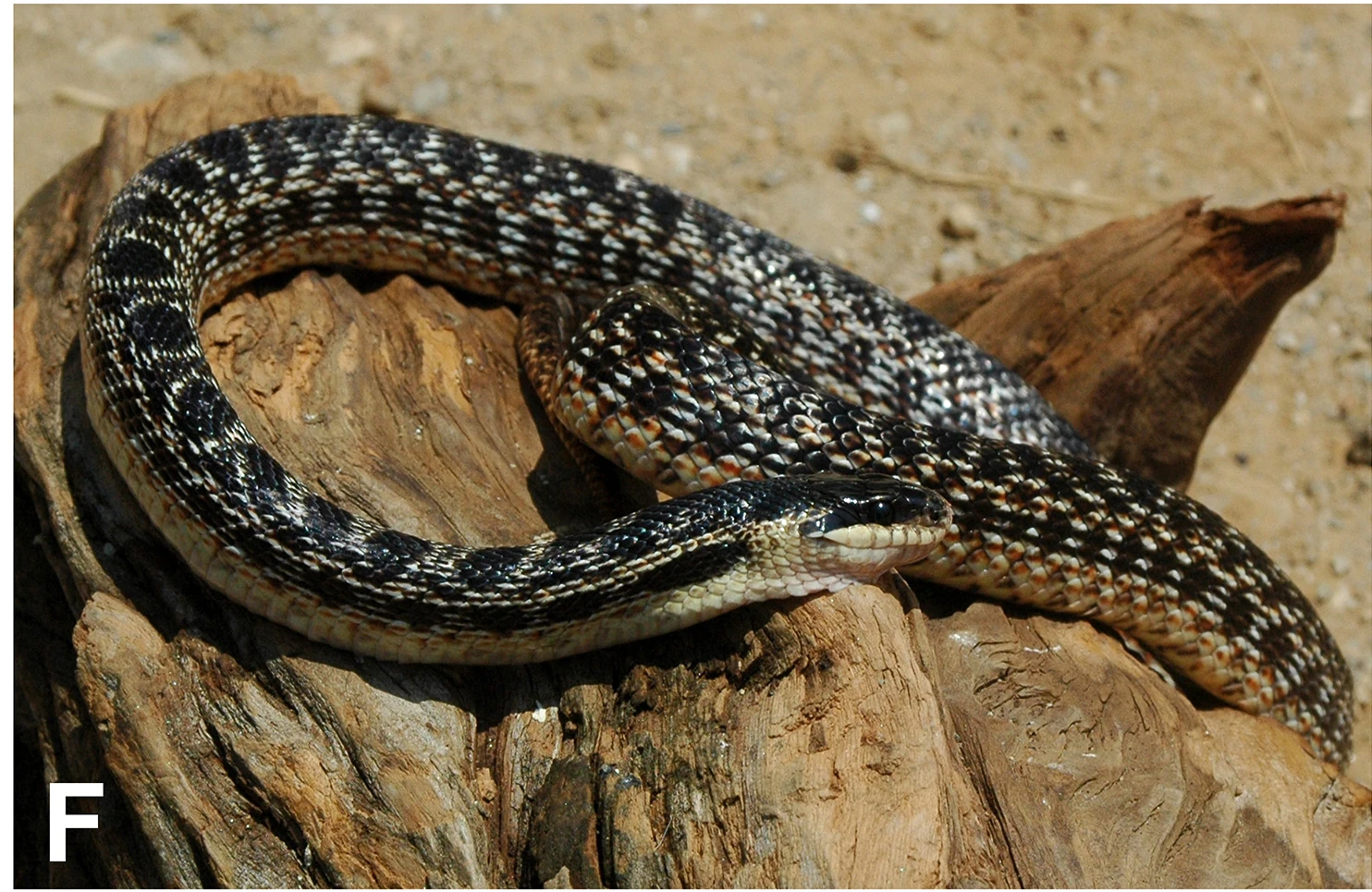
Elaphe urarticaJABLONSKI, KUKUSHKIN, AVCI, BUNYATOVA, ILGAZ, TUNIYEV & JANDZIK, 2019
Non-venomousClimbing and ground-dwelling activity is reported in the studies compiled by SquamBase. This describes the species across its studied range, not a record from every country or region.
Venom & human effects
Classified as non-venomous in the cited account of genus Elaphe; this species’ membership of that genus is verified separately.
Explicit genus-level classification applied to an exact listed member, not a species-specific venom assay or human clinical study of Elaphe urartica. The group statement does not transfer diet, body size, behaviour or medical severity. No human-harm tier is inferred.
Jablonski et al. (2023), A new, rare, small-ranged, and endangered mountain snake of the genus Elaphe from the Southern Levant, Scientific Reports 13:4839, Abstract opening sentence and Introduction explicitly characterise the genus Elaphe as non-venomous. Membership: exact-species taxonomic account Elaphe urartica.
These are editorial summaries of the linked evidence, not toxicity rankings or WHO antivenom-priority categories. Effects vary with the bite and patient. Non-venomous does not mean safe to handle.
The scientific identity
Reliable identification uses the published combination of scale characters, proportions and other diagnostic evidence. Colour or a photograph alone may not separate closely related species.
From observations & literature
Size and ecological traits credited to SquamBase summarize published studies across the species’ range in its 2024 edition. They are complemented by the locality-specific observations below.
SquamBase 1.0 records a literature maximum of 120.5 cm total length, including the tail. This is a compiled maximum, not a typical adult size or a measurement specific to this country.
[2]No sourced diet & feeding summary has yet been added to this account.
The 2024 compilation classifies activity as mainly during daylight. This range-wide summary does not exclude activity at other times.
[2]Climbing and ground-dwelling activity is reported in the studies compiled by SquamBase. This describes the species across its studied range, not a record from every country or region.
[2]Reproductive mode was not resolved in the checked treatment.
No sourced habitat & ecology summary has yet been added to this account.
Southern mountains: observation GBIF 6321034818 (2026). The original iNaturalist entry was rechecked for research-grade identification, wild status and unrestricted coordinates; its reported uncertainty footprint lies within the mapped region. This is a community-reviewed observation, not a museum voucher. Southern mountains: observation GBIF 5230530449 (2025). The original iNaturalist entry was rechecked for research-grade identification, wild status and unrestricted coordinates; its reported uncertainty footprint lies within the mapped region. This is a community-reviewed observation, not a museum voucher. Ararat & central uplands: observation GBIF 4103182476 (2022). The original iNaturalist entry was rechecked for research-grade identification, wild status and unrestricted coordinates; its reported uncertainty footprint lies within the mapped region. This is a community-reviewed observation, not a museum voucher. Ararat & central uplands: observation GBIF 5134338178 (2010). The original iNaturalist entry was rechecked for research-grade identification, wild status and unrestricted coordinates; its reported uncertainty footprint lies within the mapped region. This is a community-reviewed observation, not a museum voucher. These are dated locality records, not evidence of occurrence throughout every part of a region or a complete present-day inventory.
[3][4][5][6][7][8][9][10]Kakheti & eastern valleys: observation GBIF 6567074993 (2026). The original iNaturalist entry was rechecked for research-grade identification, wild status and unrestricted coordinates; its reported uncertainty footprint lies within the mapped region. This is a community-reviewed observation, not a museum voucher. Kakheti & eastern valleys: observation GBIF 6518723496 (2026). The original iNaturalist entry was rechecked for research-grade identification, wild status and unrestricted coordinates; its reported uncertainty footprint lies within the mapped region. This is a community-reviewed observation, not a museum voucher. These are dated locality records, not evidence of occurrence throughout every part of a region or a complete present-day inventory.
[11][12][13][14]A reported observation is not necessarily the full ecological range of a species. Where reproduction is inferred in a source dataset, the account identifies that limitation.
One species · Across borders
Explore the recorded countries and islands. Select a highlighted area to see its distribution evidence.
Loading geographic boundaries…
Click a highlighted country to zoom in and explore its records.
Shading identifies recorded countries or named islands, not continuous habitat coverage. Uncoloured areas do not establish absence.
Natural Earth · 1:50m · public domain; Gibraltar: geoBoundaries. Small islands may lack an outline.
Explore the distribution
Select a highlighted area to see its status, island records and sources. Each country and island links to the same shared species collection.
Use “Worldwide records” to include distant introduced and uncertain records in the map view.
Explicit country record in the checked taxonomic treatment. Southern mountains: observation GBIF 6321034818 (2026). The original iNaturalist entry was rechecked for research-grade identification, wild status and unrestricted coordinates; its reported uncertainty footprint lies within the mapped region. This is a community-reviewed observation, not a museum voucher. Southern mountains: observation GBIF 5230530449 (2025). The original iNaturalist entry was rechecked for research-grade identification, wild status and unrestricted coordinates; its reported uncertainty footprint lies within the mapped region. This is a community-reviewed observation, not a museum voucher. Ararat & central uplands: observation GBIF 4103182476 (2022). The original iNaturalist entry was rechecked for research-grade identification, wild status and unrestricted coordinates; its reported uncertainty footprint lies within the mapped region. This is a community-reviewed observation, not a museum voucher. Ararat & central uplands: observation GBIF 5134338178 (2010). The original iNaturalist entry was rechecked for research-grade identification, wild status and unrestricted coordinates; its reported uncertainty footprint lies within the mapped region. This is a community-reviewed observation, not a museum voucher. These are dated locality records, not evidence of occurrence throughout every part of a region or a complete present-day inventory.
Southern mountains → · Vayots Dzor
Ararat & central uplands → · Kotayk
Locality source 1 ↗ Locality source 2 ↗ Locality source 3 ↗ Locality source 4 ↗ Locality source 5 ↗ Locality source 6 ↗ Locality source 7 ↗ Locality source 8 ↗ Locality source 9 ↗Explicit country record in the checked taxonomic treatment.
Locality source 1 ↗Explicit country record in the checked taxonomic treatment. Kakheti & eastern valleys: observation GBIF 6567074993 (2026). The original iNaturalist entry was rechecked for research-grade identification, wild status and unrestricted coordinates; its reported uncertainty footprint lies within the mapped region. This is a community-reviewed observation, not a museum voucher. Kakheti & eastern valleys: observation GBIF 6518723496 (2026). The original iNaturalist entry was rechecked for research-grade identification, wild status and unrestricted coordinates; its reported uncertainty footprint lies within the mapped region. This is a community-reviewed observation, not a museum voucher. These are dated locality records, not evidence of occurrence throughout every part of a region or a complete present-day inventory.
Kakheti & eastern valleys → · Kakheti
Locality source 1 ↗ Locality source 2 ↗ Locality source 3 ↗ Locality source 4 ↗ Locality source 5 ↗Explicit country record in the checked taxonomic treatment.
Locality source 1 ↗Explicit country record in the checked taxonomic treatment.
Locality source 1 ↗Explicit country record in the checked taxonomic treatment.
Locality source 1 ↗Explicit country record in the checked taxonomic treatment.
Locality source 1 ↗Country records reviewed for this expansion: Armenia, Azerbaijan, Georgia, Iran, Iraq, Russia, Turkey. These records do not imply continuous occupancy; unresolved identities are excluded from confirmed counts. [1]
The text retains the source’s geographic qualifications. The map shows countries with atlas occurrence records; it is not a complete global range model. A type locality is a nomenclatural reference, not the only place the species occurs.
Status & its meaning
No matching global assessment was verified for this account. This is an unresolved assessment link, not an IUCN “Not Evaluated” classification and not evidence that the species is secure.
Locality coverage in the atlas does not measure abundance, population trends or national legal protection.
Follow the evidence
Latest evidence added 2026-10-29. Taxonomic and distribution treatments may change.
The linked taxonomic treatment provides its original descriptions, revisions and bibliography. Observations from other countries are not relabelled as local field studies.