
Size & measurements
Recorded size
SquamBase 1.0 records a literature maximum of 150 cm total length, including the tail. This is a compiled maximum, not a typical adult size or a measurement specific to this country.
[2]Viperidae · Species account
Daboia siamensis(SMITH, 1917)
VenomousPotentially life-threateningGround-dwelling activity is reported in the studies compiled by SquamBase. This describes the species across its studied range, not a record from every island.
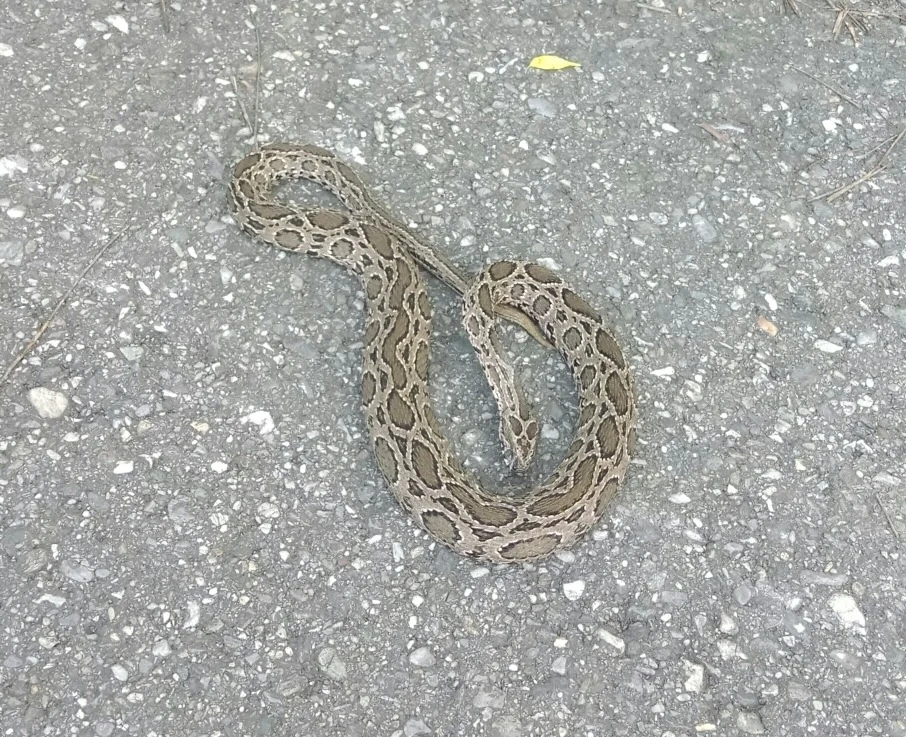
Venom & human effects
A Myanmar hospital study attributed 686 bites to the eastern Russell’s viper. Acute kidney injury occurred in 488 patients, 213 required dialysis, and 84 died.
The authors explicitly acknowledge assumed identity in part of this cohort: medical-staff specimen examination or patient recognition plus clinical syndrome, without venom testing or independent confirmation for all cases. The figures describe this hospital cohort, not the probability after any bite.
Alfred et al.2019, Results, Table1 and Limitations.
These are editorial summaries of the linked evidence, not toxicity rankings or WHO antivenom-priority categories. Effects vary with the bite and patient. Non-venomous does not mean safe to handle.
The scientific identity
Reliable identification uses the published combination of scale characters, proportions and other diagnostic evidence. Colour or a photograph alone may not separate closely related species.
Taxonomic treatment & original-description references ↗
Vipera russelli · Vipera russelii · Daboia russelli · Daboia russelii · Daboia russellii
Names trace the literature, including older combinations and historical usages. Their appearance here does not mean they are all currently accepted synonyms.
From observations & literature
Size and ecological traits credited to SquamBase summarize published studies across the species’ range in its 2024 edition. They are complemented by the locality-specific observations below.
SquamBase 1.0 records a literature maximum of 150 cm total length, including the tail. This is a compiled maximum, not a typical adult size or a measurement specific to this country.
[2]Recorded prey include rats, birds, snakes, lizards, frogs, amphibians and mammals. This is a compiled list of food records, not an exclusive diet.
Exact-name row in the 2024 literature compilation. These are records from studied populations, not typical values, an exhaustive biological account, or evidence of occurrence in every region.
SquamBase 1.0, Supplementary Table S1, row 8637: Daboia siamensis; columns Diet, Diet metadata.
The 2024 compilation classifies activity as mainly after dark. This range-wide summary does not exclude activity at other times.
[2]Ground-dwelling activity is reported in the studies compiled by SquamBase. This describes the species across its studied range, not a record from every island.
[2]Live-bearing. The source marks this as an inference rather than a breeding observation.
[3]Published records compiled in SquamBase report 20–64 young per litter. These are the smallest and largest reported broods in the compilation, not a typical brood size or a complete limit for the species.
Exact-name row in the 2024 literature compilation. These are records from studied populations, not typical values, an exhaustive biological account, or evidence of occurrence in every region.
SquamBase 1.0, Supplementary Table S1, row 8637: Daboia siamensis; columns Mode of reproduction, Mode of reproduction metadata, smallest brood, largest brood, brood size metadata.
The cited compilation records microhabitat use including ground-level habitats.
Exact-name entry in the 2024 SquamBase literature compilation, using an explicitly populated trait and its cited metadata. Records reflect the studied populations; they do not establish uniform behaviour across all seasons, ages or localities. Historical species concepts requiring review and imputed/uncertain metadata are excluded. This describes substrate or microhabitat use, not vegetation, a geographical range, or use of every habitat in that range.
SquamBase 1.0, Supplementary Table S1, row 8637: Daboia siamensis; columns substrate and substrate metadata. Recorded value: Terrestrial. Original source metadata: Terrestrial (Feldman 2015, Chanhome 2011, Cox et al. 2012)
Myanmar is explicitly listed in the checked individual taxonomic treatment.
[3]Taiwan is explicitly listed in the checked individual taxonomic treatment.
[3]China is explicitly recorded in the checked individual species treatment. The accepted identity is also represented in the 2025 checklist; regional inclusion here is based on explicit locality evidence, not the checklist’s broader geographical scope. Named regional records: Fujian. These localities do not imply continuous occupation of the entire region.
[4][5]Live-bearing; the source uses viviparous. [1]
A reported observation is not necessarily the full ecological range of a species. Where reproduction is inferred in a source dataset, the account identifies that limitation.
One species · Across borders
Explore the recorded countries and islands. Select a highlighted area to see its distribution evidence.
Loading geographic boundaries…
Click a highlighted country to zoom in and explore its records.
Shading identifies recorded countries or named islands, not continuous habitat coverage. Uncoloured areas do not establish absence.
Natural Earth · 1:50m · public domain; Gibraltar: geoBoundaries. Small islands may lack an outline.
Explore the distribution
Select a highlighted area to see its status, island records and sources. Each country and island links to the same shared species collection.
Use “Worldwide records” to include distant introduced and uncertain records in the map view.
China is explicitly recorded in the checked individual species treatment. The accepted identity is also represented in the 2025 checklist; regional inclusion here is based on explicit locality evidence, not the checklist’s broader geographical scope. Named regional records: Fujian. These localities do not imply continuous occupation of the entire region.
Eastern hills, rivers & coast → · Fujian
Locality source 1 ↗ Locality source 2 ↗Taiwan is explicitly listed in the checked individual taxonomic treatment.
Locality source 1 ↗Thailand: Bangkok.
Central plains → · Bangkok
Locality source 1 ↗Myanmar is explicitly listed in the checked individual taxonomic treatment.
Locality source 1 ↗Source explicitly lists Indonesian occurrence; no contrary country-level exclusion in Comment.
This expansion documents Thailand, Myanmar. Consult the original treatment and global occurrence map for the wider range. [1]
The text retains the source’s geographic qualifications. The map shows countries with atlas occurrence records; it is not a complete global range model. A type locality is a nomenclatural reference, not the only place the species occurs.
Status & its meaning
No matching global assessment was verified for this account. This is an unresolved assessment link, not an IUCN “Not Evaluated” classification and not evidence that the species is secure.
Locality coverage in the atlas does not measure abundance, population trends or national legal protection.
Follow the evidence
Latest evidence added 2026-10-11. Taxonomic and distribution treatments may change.
The linked taxonomic treatment provides its original descriptions, revisions and bibliography. Observations from other countries are not relabelled as local field studies.