Conservation context
The 2016 assessment identifies development and persecution as threats; it does not supply a current population estimate.
Sources: CARMABI · Christoffelpark nature · IUCN (2016) · Erythrolamprus triscalis assessment
Curaçao · Habitat field guide
Curaçao’s endemic groundsnake is associated with dry forest and shrubland, with moist refuges within that dry landscape. Christoffelpark provides a documented protected-area setting.
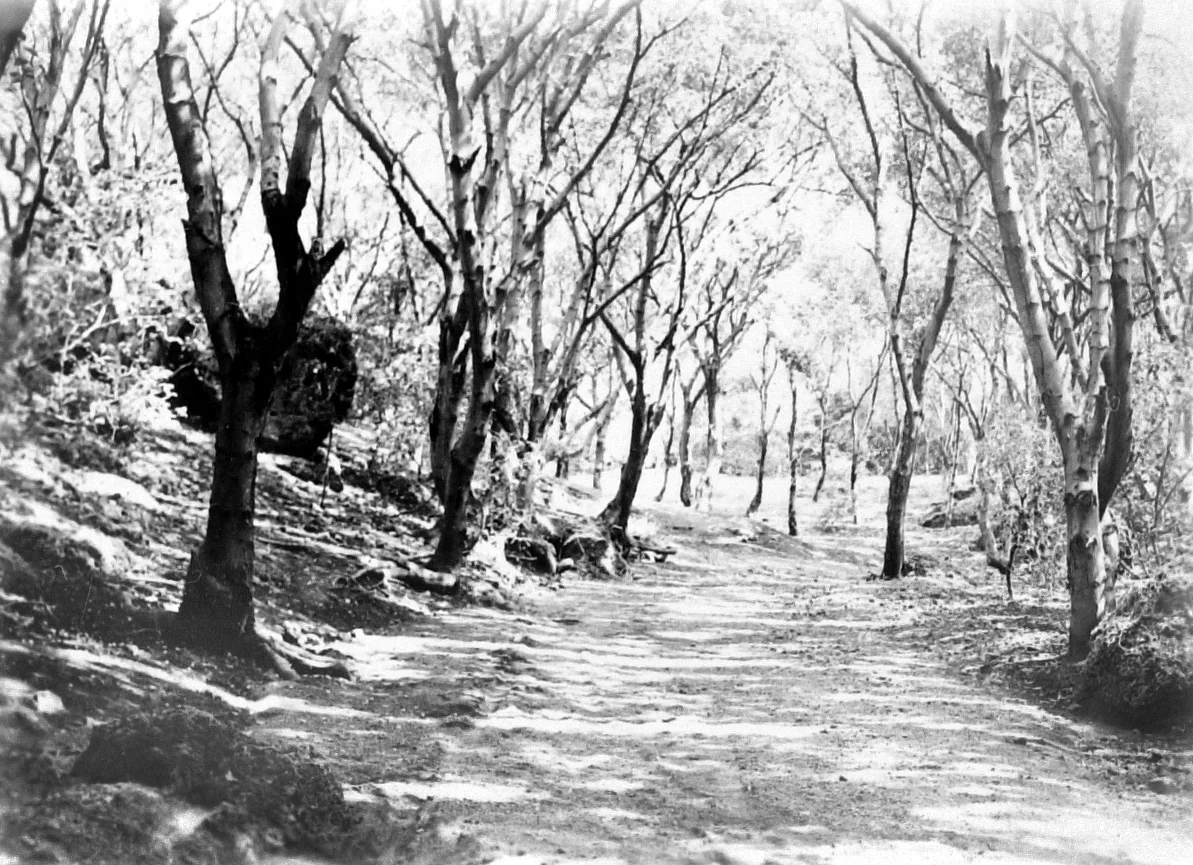
Historical photograph of a path through manzanilla woodland at Westpunt, Curaçao, in 1936. Museum record TM-10021833; the photograph does not document present-day forest condition.
Understanding the environment
Curaçao’s endemic groundsnake is associated with dry forest and shrubland, with moist refuges within that dry landscape. Christoffelpark provides a documented protected-area setting.
Explore the structure · Follow the named landscape settings
Select a zone to see what changes.
Shade
Dry woodland retains sheltered ground.
Use the linked source for the local setting; no animal occurrence follows from this zone alone.
A conceptual habitat reading, not a measured transect or a snake distribution map.
Sources: CARMABI · Christoffelpark nature · IUCN (2016) · Erythrolamprus triscalis assessment
Field notes · 01
Curaçao’s endemic groundsnake is associated with dry forest and shrubland, with moist refuges within that dry landscape. Christoffelpark provides a documented protected-area setting.
Sources: CARMABI · Christoffelpark nature · IUCN (2016) · Erythrolamprus triscalis assessment
Field notes · 02
The country catalogue uses independently checked snake records. Habitat suitability alone does not establish occupancy, and a published historical record does not establish current abundance.
Sources: CARMABI · Christoffelpark nature · IUCN (2016) · Erythrolamprus triscalis assessment
Pressures on Curaçao’s habitats
The 2016 assessment identifies development and persecution as threats; it does not supply a current population estimate.
Sources: CARMABI · Christoffelpark nature · IUCN (2016) · Erythrolamprus triscalis assessment
Keep to established access routes, leave shelter in place and follow local protected-area rules. Report unusual introduced animals to the relevant local conservation authority.
The connected collection
These 2 species have supported country occurrence and an explicit habitat association in the shared account. The association may come from elsewhere in their range. This is not a complete local habitat inventory; the places above are landscape examples, not asserted collecting sites.
2 species · showing 2
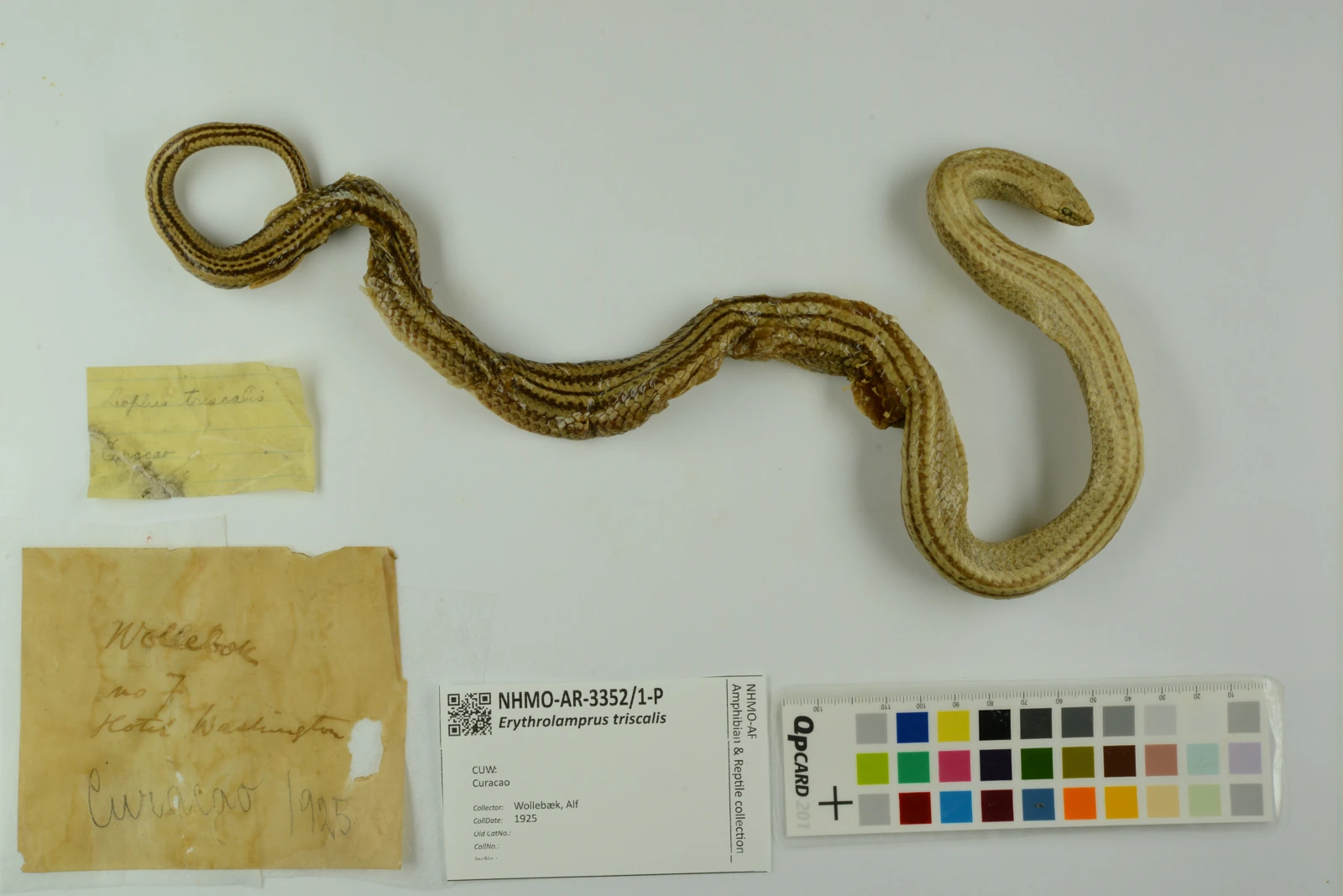
001 · Colubridae
Three-scaled Groundsnake
Native Curaçao endemic; Christoffelpark and the IUCN range assessment support the main island. No Klein Curaçao record inferred.
Read the species account →Eileen Westwig, NHM · CC BY 4.0 · https://creativecommons.org/licenses/by/4.0/

002 · Typhlopidae
Flowerpot Snake
Introduced; published localities include Coral Estate and Jan Thielbaai. These records do not establish occurrence throughout natural dry country.
Read the species account →Cook-Price, Makchai & Suwanwaree (2026); photographs credited collectively to the author, James Covert and Vikas Kumar · CC BY 4.0 · https://creativecommons.org/licenses/by/4.0/
Read further
Guide reviewed 2026-10-28. Source dates and geographic scope matter; landscape photographs do not establish species occurrence.
Park vegetation and its endemic groundsnake; a positive main-island record.
Curaçao endemic distribution, dry forest/shrubland and moist refuges. Assessment date retained; not a 2026 population estimate.
Continue through Curaçao
Dry shrubland and cactus vegetation are part of Curaçao’s terrestrial setting. Rain changes the appearance of this dry landscape without turning every exposed site into a snake locality.
02Klein Curaçao’s Ramsar site combines a small island with surrounding reefs. Its beaches support nesting turtles, while low terrestrial vegetation and seabird habitat occupy the island.