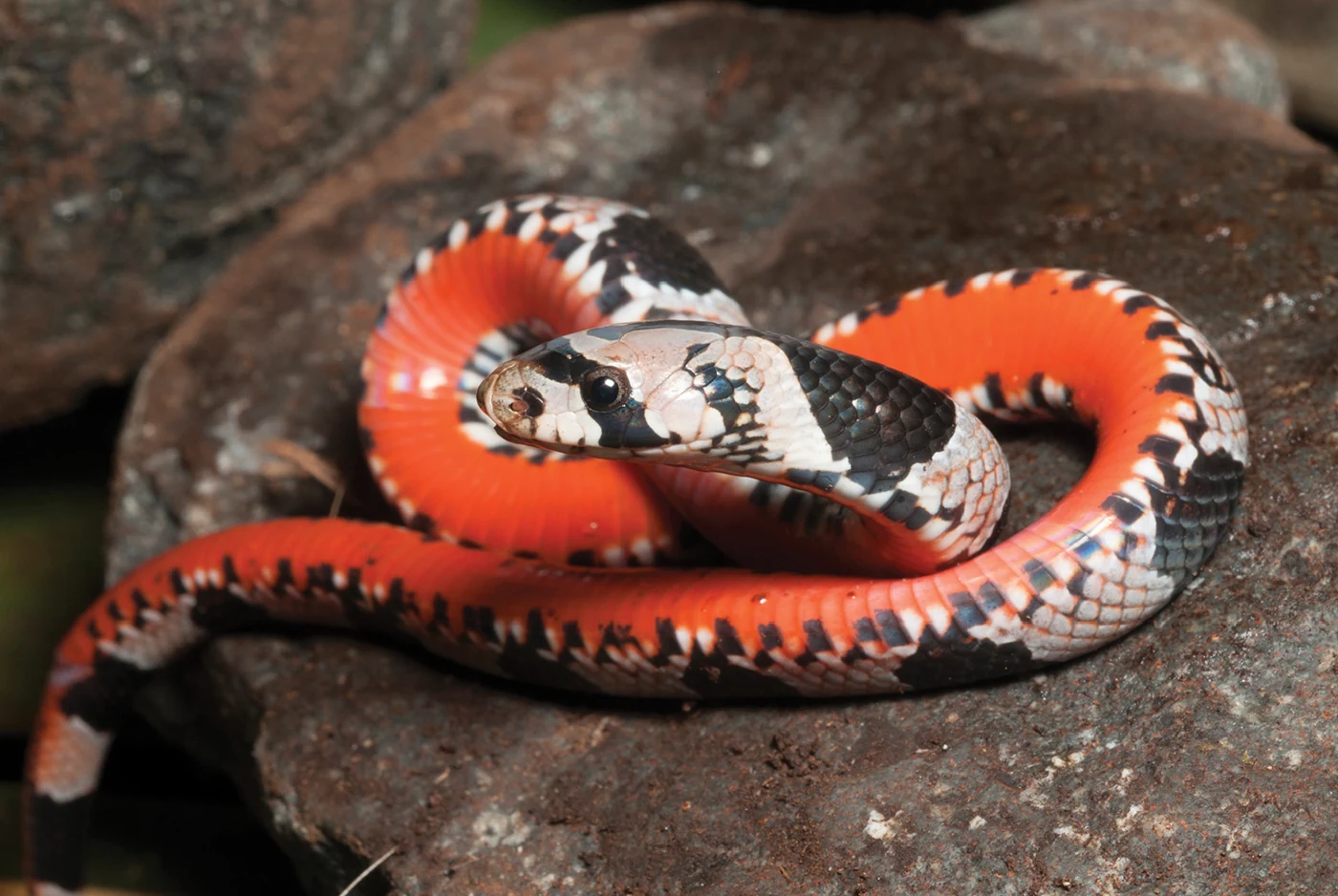
A forest-associated snake recorded at low to middle elevations in northeast Mindanao. Its atlas account links 2 named island or island-group records to the source literature.
OccurrenceConfirmed
Islands named2
Natural history7 sourced entries
References4
Literature updated 2026-10-07 · Editorial review pending
Reserved for a contributor imageCredit and usage rights will accompany the image.Juvenile Oligodon maculatus, KU 334450, at Eye Falls, Mt Hilong-hilong, Mindanao; Sanguila et al. (2016), figure 70. Juvenile status is stated in the original caption.Rafe M. Brown · CC BY 4.0 · https://creativecommons.org/licenses/by/4.0/
Life stages will be labelled from the contributor’s information. Images alone do not establish identification or a locality record.
Media provenance
Every image carries its source.
Juvenile Oligodon maculatus, KU 334450, at Eye Falls, Mt Hilong-hilong, Mindanao; Sanguila et al. (2016), figure 70. Juvenile status is stated in the original caption.
Voucher KU334450 explicitly identified as Oligodon maculatus; original caption explicitly calls it juvenile. No age inferred from size. Whole original photograph retained; resized and converted to WebP. No object retouching or synthesis. The shared layout may crop the displayed frame. Source checked 2026-10-29. This photograph does not establish occurrence in every country displaying the profile; age and sex are not inferred.
Classified as non-venomous in the cited description of genus Oligodon; this species’ current membership is verified separately.
Explicit genus-level classification applied to a verified accepted member. The source does not provide a species-specific venom assay or human clinical study.
Evidence & scope · checked 2026-10-30
Neang & Hun (2013), First record of Oligodon annamensis Leviton, 1953 (Squamata: Colubridae) from the Cardamom Mountains of southwest Cambodia, Herpetology Notes 6:271–273. Opening paragraph, p.271, explicitly describes the kukri-snake genus as non-venomous. Current membership: Reptile Database genus search, exact accepted listing Oligodon maculatus, checked 2026-10-30.
The cited human cases reported limited effects. Sparse observations cannot exclude a severe reaction.
Medically significant effects
The cited human cases document clinically important injury or illness. This is not an upper limit on severity.
Potentially life-threatening
Species-specific clinical evidence documents life-threatening illness or deaths after bites. The account explains the affected patients and any uncertainty about the cause.
Clinical severity not established
Venom presence is documented, but the reviewed evidence does not establish a clinical tier. When human effects are reported under an unresolved historical species name, the badge and account say so explicitly.
Venom status uncertain
The reviewed sources are inconclusive or conflicting about venom presence. The account explains the uncertainty.
Venom status not assessed
The atlas lacks a reviewed venom-presence classification for this species.
These are editorial summaries of the linked evidence, not toxicity rankings or WHO antivenom-priority categories. Effects vary with the bite and patient. Non-venomous does not mean safe to handle.
A closer look
Natural history & identification
Ecology & habitat
A forest-associated snake recorded at low to middle elevations in northeast Mindanao.
No numerical elevational limits or habitat-selection results are supplied here.
Reproduction
The species account records egg-laying reproduction. A verified Philippine clutch-size range, incubation interval and breeding calendar are not established here.
Reproductive mode reported for this named species.
Mode alone does not establish litter or clutch size, seasonal timing, or captive husbandry requirements.
Philippine distribution
The atlas records Oligodon maculatus from these named Philippine areas: Mindanao, Leyte. These are literature areas rather than a continuous range boundary.
Literature documented · Existing checklist occurrence statement and distribution review
The original evidence level is retained.
A country listing cannot establish an island or a precise locality.
Taxonomic context
Oligodon maculatus is retained in the atlas’s dated checklist under Colubridae. The authority is (TAYLOR 1918). Earlier names and the original source notes are preserved below for comparison.
Literature documented · Checklist identity and nomenclatural trail
Checklist verified 2026-09-05; not a newly revised taxonomic backbone.
Historical names can cover different biological concepts; synonyms should not be used to transfer records automatically.
Additional sourced biology
Biology & natural history
Size & measurements
The compilation reports a maximum total length of 29.9 cm. This is a recorded maximum, not a typical adult size.
Exact-name entry in the 2024 SquamBase literature compilation, using an explicitly populated trait and its cited metadata. Records reflect the studied populations; they do not establish uniform behaviour across all seasons, ages or localities. Historical species concepts requiring review and imputed/uncertain metadata are excluded. Length is the compiler's largest accepted reported total length, not a new measurement, average, or current absolute biological limit. No allometric mass estimate is used.
Study & evidence
SquamBase 1.0, Supplementary Table S1, row 9996: Oligodon maculatus; columns maximum total length (mm) and size metadata. Recorded value: 299. Original source metadata: 299 mm total length (Feldman et al. 2016)
The cited compilation lists egg-laying reproduction.
Exact-name entry in the 2024 SquamBase literature compilation, using an explicitly populated trait and its cited metadata. Records reflect the studied populations; they do not establish uniform behaviour across all seasons, ages or localities. Historical species concepts requiring review and imputed/uncertain metadata are excluded. The compilation groups ovoviviparity with viviparity; this is a statement of live birth, not evidence for a particular embryonic nourishment mechanism.
Study & evidence
SquamBase 1.0, Supplementary Table S1, row 9996: Oligodon maculatus; columns Mode of reproduction and Mode of reproduction metadata. Recorded value: Oviparous. Original source metadata: oviparous (Feldman et al. 2015)
The cited compilation records microhabitat use including ground-level habitats.
Exact-name entry in the 2024 SquamBase literature compilation, using an explicitly populated trait and its cited metadata. Records reflect the studied populations; they do not establish uniform behaviour across all seasons, ages or localities. Historical species concepts requiring review and imputed/uncertain metadata are excluded. This describes substrate or microhabitat use, not vegetation, a geographical range, or use of every habitat in that range.
Study & evidence
SquamBase 1.0, Supplementary Table S1, row 9996: Oligodon maculatus; columns substrate and substrate metadata. Recorded value: Terrestrial. Original source metadata: "surficial (terrestrial, non-scansorial)" (Gearty et al. 2021)
Documented islands: gold · island groups: dashed circles
Island-level records · not continuous habitat coverage. Dashed circles locate groups, not individual observations.
Philippine distribution
Documented places
2 named islands / island groups
Select an island to read its distribution record and sources. Uncoloured islands are not evidence of absence.
Distribution record & sources
Philippines (Mindanao, Leyte)
Type locality: Bunawan, Agusan, Philippines.
The atlas records Oligodon maculatus from these named Philippine areas: Mindanao, Leyte. These are literature areas rather than a continuous range boundary.
Venom classification not yet added · Effects not yet summarised in this atlas
Observe from a distance. Do not handle, corner or capture a snake to identify it. An incomplete venom account is not evidence that a species is safe to handle.
After a suspected snakebite, keep the person still and arrange urgent medical care. Avoid tight tourniquets, cutting, suction and unproven remedies. Do not wait to identify the snake before seeking help.
Oligodon maculatus — The Reptile Database species account
Uetz, P.; Hallermann, J. et al. (editors)
Public species fields consulted for bounded biological summaries. Primary sources quoted within the database were not independently examined unless explicitly stated. The catalogue name may differ from the current source title.