Size & measurements
No sourced size & measurements summary has yet been added to this account.
Uropeltidae · Species account
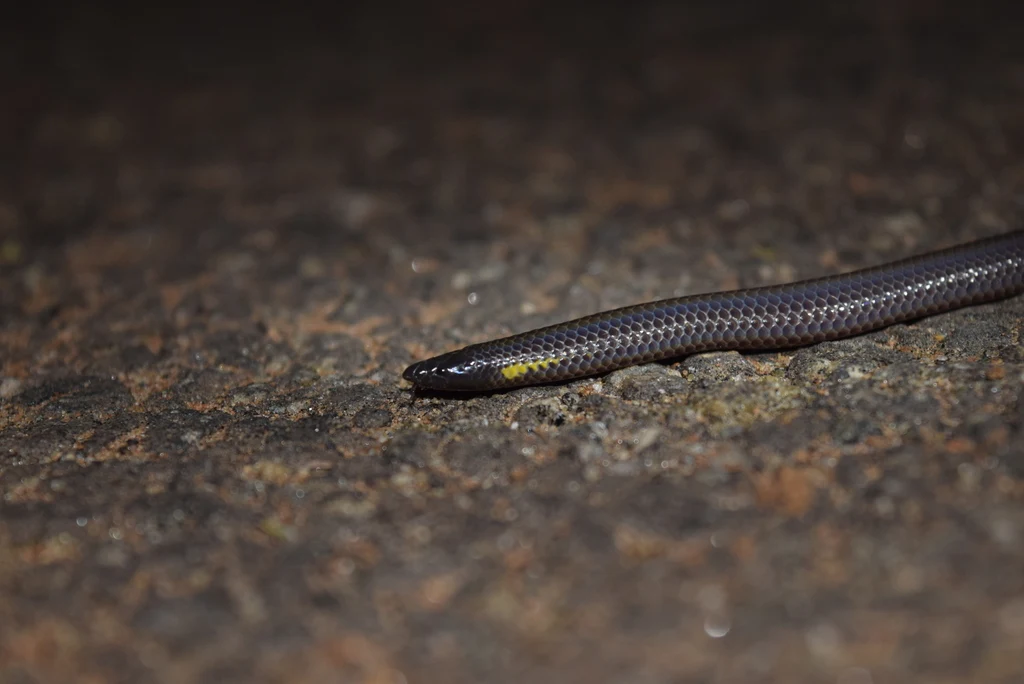
Uropeltis bhupathyiJINS, SAMPAIO & GOWER, 2018
Non-venomousIndia is explicitly listed in the checked individual taxonomic treatment. The national ZSI checklist independently lists Uropeltis bhupathyi. Regional evidence: Tamil Nadu. Named records do not imply continuous occurrence throughout a region.
Venom & human effects
Assessed as non-venomous from an explicit source statement about uropeltids, with this species’ membership checked separately.
Group-level assessment, not an individual venom study of Uropeltis bhupathyi. The paper makes a family-wide venom-presence statement. Its predation experiments do not independently test venom in every member species. This classification does not describe other possible injuries from a bite or constriction.
Cyriac & Kodandaramaiah (2019), Abstract, first sentence; PMID 31428543. Membership: exact-species Reptile Database Higher Taxa field (Uropeltidae, Henophidia, Alethinophidia, Serpentes, Squamata (snakes)).
These are editorial summaries of the linked evidence, not toxicity rankings or WHO antivenom-priority categories. Effects vary with the bite and patient. Non-venomous does not mean safe to handle.
The scientific identity
Reliable identification uses the published combination of scale characters, proportions and other diagnostic evidence. Colour or a photograph alone may not separate closely related species.
From observations & literature
No sourced size & measurements summary has yet been added to this account.
No sourced diet & feeding summary has yet been added to this account.
The cited compilation records activity during both day and night.
Exact-name entry in the 2024 SquamBase literature compilation, using an explicitly populated trait and its cited metadata. Records reflect the studied populations; they do not establish uniform behaviour across all seasons, ages or localities. Historical species concepts requiring review and imputed/uncertain metadata are excluded.
SquamBase 1.0, Supplementary Table S1, row 11155: Uropeltis bhupathyi; columns Activity time and Activity time metadata. Recorded value: Cathemeral. Original source metadata: "all specimens observed by the first author were seen on the surface in the morning or evening on overcast days, often after or during rainfall." (Jins et al. 2018) (recorded by Anuj Shinde),
The cited taxonomic account reports handled individuals coiling around the observer’s hand without attempting to bite. This describes those observations, not a guarantee about every individual.
Explicit information assigned to this exact species in the cited taxonomic compilation. Original citations are retained where the account supplies them; an uncited entry is not presented as a primary study. Local, specimen-specific, captive and uncertain statements retain those limits. No venom or human-danger classification is inferred.
The Reptile Database, Uropeltis bhupathyi, Comment field, Behavior paragraph.
Live-bearing. The source marks this as an inference rather than a breeding observation.
[1]The cited compilation records microhabitat use including burrowing.
Exact-name entry in the 2024 SquamBase literature compilation, using an explicitly populated trait and its cited metadata. Records reflect the studied populations; they do not establish uniform behaviour across all seasons, ages or localities. Historical species concepts requiring review and imputed/uncertain metadata are excluded. This describes substrate or microhabitat use, not vegetation, a geographical range, or use of every habitat in that range.
SquamBase 1.0, Supplementary Table S1, row 11155: Uropeltis bhupathyi; columns substrate and substrate metadata. Recorded value: Fossorial. Original source metadata: Fossorial (Jins et al. 2018)
The cited taxonomic account reports roughly 15 individuals seen at the type locality, on the surface in the morning or evening during overcast conditions, often with rainfall. Burrowing was proposed but had not been tested through digging surveys.
Explicit information assigned to this exact species in the cited taxonomic compilation. Original citations are retained where the account supplies them; an uncited entry is not presented as a primary study. Local, specimen-specific, captive and uncertain statements retain those limits. No venom or human-danger classification is inferred.
The Reptile Database, Uropeltis bhupathyi, Comment field, Habitat paragraph. Citations in this paragraph: (e.g., Rajendran 1985).
A reported observation is not necessarily the full ecological range of a species. Where reproduction is inferred in a source dataset, the account identifies that limitation.
One species · Across borders
Explore the recorded countries and islands. Select a highlighted area to see its distribution evidence.
Loading geographic boundaries…
Click a highlighted country to zoom in and explore its records.
Shading identifies recorded countries or named islands, not continuous habitat coverage. Uncoloured areas do not establish absence.
Natural Earth · 1:50m · public domain; Gibraltar: geoBoundaries. Small islands may lack an outline.
Explore the distribution
Select a highlighted area to see its status, island records and sources. Each country and island links to the same shared species collection.
Use “Worldwide records” to include distant introduced and uncertain records in the map view.
India is explicitly listed in the checked individual taxonomic treatment. The national ZSI checklist independently lists Uropeltis bhupathyi. Regional evidence: Tamil Nadu. Named records do not imply continuous occurrence throughout a region.
Southern peninsula → · Tamil Nadu
Locality source 1 ↗ Locality source 2 ↗Verified country records in this account: India. These are occurrence records, not continuous range polygons. Detailed locality evidence and taxonomic qualifications are documented below. [1][2]
The text retains the source’s geographic qualifications. The map shows countries with atlas occurrence records; it is not a complete global range model. A type locality is a nomenclatural reference, not the only place the species occurs.
Status & its meaning
No matching global assessment was verified for this account. This is an unresolved assessment link, not an IUCN “Not Evaluated” classification and not evidence that the species is secure.
Locality coverage in the atlas does not measure abundance, population trends or national legal protection.
Follow the evidence
Latest evidence added 2026-10-28. Taxonomic and distribution treatments may change.
The linked taxonomic treatment provides its original descriptions, revisions and bibliography. Observations from other countries are not relabelled as local field studies.