Size & measurements
No sourced size & measurements summary has yet been added to this account.
Boidae · Species account
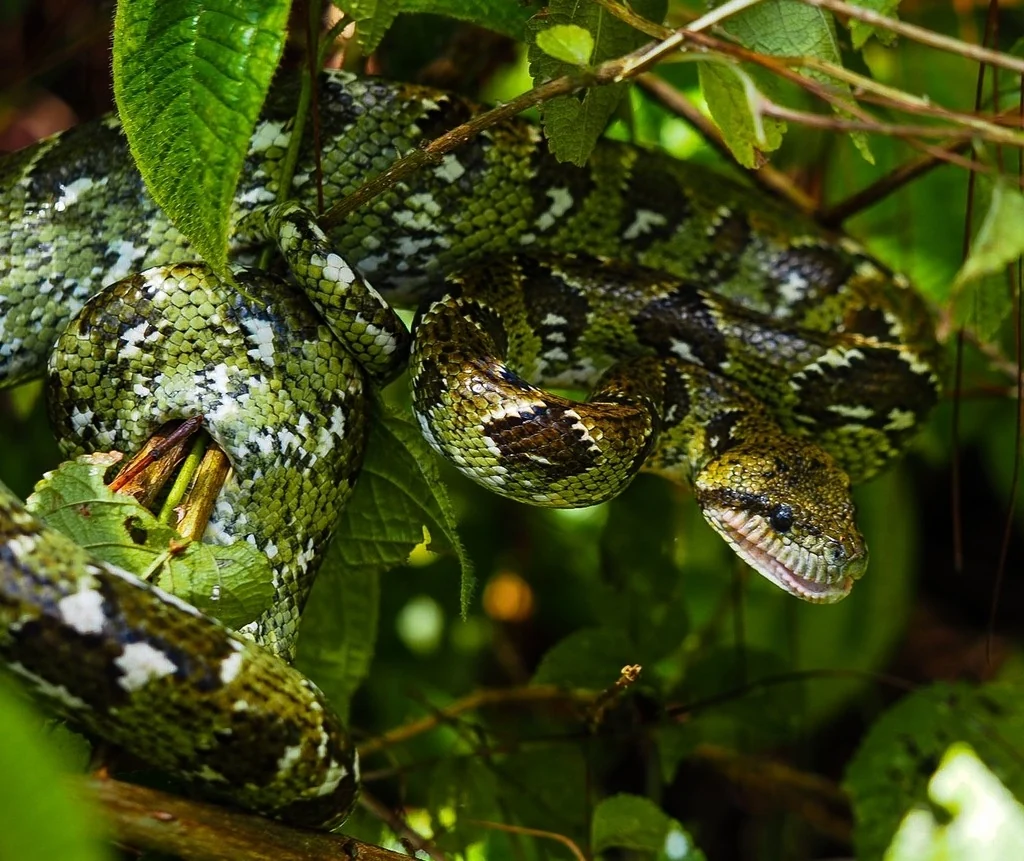
Sanzinia madagascariensis(DUMÉRIL & BIBRON, 1844)
Non-venomousClimbing and ground-dwelling activity is reported in the studies compiled by SquamBase. This describes the species across its studied range, not a record from every country or region.
Venom & human effects
Assessed as non-venomous from an explicit source statement about boas, with this species’ membership checked separately.
Group-level assessment, not an individual venom study of Sanzinia madagascariensis. The zoo account explicitly names Boidae and discusses boas across continents. Its old species totals are not used. Only exact Boidae membership in the retained taxonomy is used; other families with boa in a common name are excluded. This classification does not describe other possible injuries from a bite or constriction.
Family: Boidae; About section, paragraph beginning Not the bad guys. Membership: exact-species Reptile Database Higher Taxa field (Boidae (Sanziniinae, Sanziniidae), Booidea, Henophidia, Alethinophidia, Serpentes, Squamata (snakes)).
These are editorial summaries of the linked evidence, not toxicity rankings or WHO antivenom-priority categories. Effects vary with the bite and patient. Non-venomous does not mean safe to handle.
The scientific identity
Reliable identification uses the published combination of scale characters, proportions and other diagnostic evidence. Colour or a photograph alone may not separate closely related species.
From observations & literature
Size and ecological traits credited to SquamBase summarize published studies across the species’ range in its 2024 edition. They are complemented by the locality-specific observations below.
No sourced size & measurements summary has yet been added to this account.
No sourced diet & feeding summary has yet been added to this account.
The 2024 compilation classifies activity as mainly after dark. This range-wide summary does not exclude activity at other times.
[2]Climbing and ground-dwelling activity is reported in the studies compiled by SquamBase. This describes the species across its studied range, not a record from every country or region.
[2]Live-bearing.
No sourced habitat & ecology summary has yet been added to this account.
Eastern forests & coast: observation GBIF 6179184401 (2026). The original iNaturalist entry was rechecked for research-grade identification, wild status and unrestricted coordinates; its reported uncertainty footprint lies within the mapped region. This is a community-reviewed observation, not a museum voucher. Eastern forests & coast: observation GBIF 6162779233 (2026). The original iNaturalist entry was rechecked for research-grade identification, wild status and unrestricted coordinates; its reported uncertainty footprint lies within the mapped region. This is a community-reviewed observation, not a museum voucher. Southern regions: observation GBIF 6235990715 (2026). The original iNaturalist entry was rechecked for research-grade identification, wild status and unrestricted coordinates; its reported uncertainty footprint lies within the mapped region. This is a community-reviewed observation, not a museum voucher. Southern regions: observation GBIF 4868172923 (2024). The original iNaturalist entry was rechecked for research-grade identification, wild status and unrestricted coordinates; its reported uncertainty footprint lies within the mapped region. This is a community-reviewed observation, not a museum voucher. Central highlands: observation GBIF 6469828914 (2026). The original iNaturalist entry was rechecked for research-grade identification, wild status and unrestricted coordinates; its reported uncertainty footprint lies within the mapped region. This is a community-reviewed observation, not a museum voucher. Central highlands: observation GBIF 5892455810 (2025). The original iNaturalist entry was rechecked for research-grade identification, wild status and unrestricted coordinates; its reported uncertainty footprint lies within the mapped region. This is a community-reviewed observation, not a museum voucher. Diana & Sava: observation GBIF 6163259508 (2025). The original iNaturalist entry was rechecked for research-grade identification, wild status and unrestricted coordinates; its reported uncertainty footprint lies within the mapped region. This is a community-reviewed observation, not a museum voucher. Diana & Sava: observation GBIF 6163313699 (2025). The original iNaturalist entry was rechecked for research-grade identification, wild status and unrestricted coordinates; its reported uncertainty footprint lies within the mapped region. This is a community-reviewed observation, not a museum voucher. These are dated locality records, not evidence of occurrence throughout every part of a region or a complete present-day inventory.
[3][4][5][6][7][8][9][10][11][12][13][14][15][16][17][18]A reported observation is not necessarily the full ecological range of a species. Where reproduction is inferred in a source dataset, the account identifies that limitation.
One species · Across borders
Explore the recorded countries and islands. Select a highlighted area to see its distribution evidence.
Loading geographic boundaries…
Click a highlighted country to zoom in and explore its records.
Shading identifies recorded countries or named islands, not continuous habitat coverage. Uncoloured areas do not establish absence.
Natural Earth · 1:50m · public domain; Gibraltar: geoBoundaries. Small islands may lack an outline.
Explore the distribution
Select a highlighted area to see its status, island records and sources. Each country and island links to the same shared species collection.
Use “Worldwide records” to include distant introduced and uncertain records in the map view.
The current taxonomic treatment explicitly lists this country. This is country-scale checklist evidence, not a claim of continuous occupancy or a complete regional inventory. Eastern forests & coast: observation GBIF 6179184401 (2026). The original iNaturalist entry was rechecked for research-grade identification, wild status and unrestricted coordinates; its reported uncertainty footprint lies within the mapped region. This is a community-reviewed observation, not a museum voucher. Eastern forests & coast: observation GBIF 6162779233 (2026). The original iNaturalist entry was rechecked for research-grade identification, wild status and unrestricted coordinates; its reported uncertainty footprint lies within the mapped region. This is a community-reviewed observation, not a museum voucher. Southern regions: observation GBIF 6235990715 (2026). The original iNaturalist entry was rechecked for research-grade identification, wild status and unrestricted coordinates; its reported uncertainty footprint lies within the mapped region. This is a community-reviewed observation, not a museum voucher. Southern regions: observation GBIF 4868172923 (2024). The original iNaturalist entry was rechecked for research-grade identification, wild status and unrestricted coordinates; its reported uncertainty footprint lies within the mapped region. This is a community-reviewed observation, not a museum voucher. Central highlands: observation GBIF 6469828914 (2026). The original iNaturalist entry was rechecked for research-grade identification, wild status and unrestricted coordinates; its reported uncertainty footprint lies within the mapped region. This is a community-reviewed observation, not a museum voucher. Central highlands: observation GBIF 5892455810 (2025). The original iNaturalist entry was rechecked for research-grade identification, wild status and unrestricted coordinates; its reported uncertainty footprint lies within the mapped region. This is a community-reviewed observation, not a museum voucher. Diana & Sava: observation GBIF 6163259508 (2025). The original iNaturalist entry was rechecked for research-grade identification, wild status and unrestricted coordinates; its reported uncertainty footprint lies within the mapped region. This is a community-reviewed observation, not a museum voucher. Diana & Sava: observation GBIF 6163313699 (2025). The original iNaturalist entry was rechecked for research-grade identification, wild status and unrestricted coordinates; its reported uncertainty footprint lies within the mapped region. This is a community-reviewed observation, not a museum voucher. These are dated locality records, not evidence of occurrence throughout every part of a region or a complete present-day inventory.
Eastern forests & coast → · Eastern forests & coast
Southern regions → · Southern regions
Central highlands → · Central highlands
Diana & Sava → · Diana & Sava
Locality source 1 ↗ Locality source 2 ↗ Locality source 3 ↗ Locality source 4 ↗ Locality source 5 ↗ Locality source 6 ↗ Locality source 7 ↗ Locality source 8 ↗ Locality source 9 ↗ Locality source 10 ↗ Locality source 11 ↗ Locality source 12 ↗ Locality source 13 ↗ Locality source 14 ↗ Locality source 15 ↗ Locality source 16 ↗ Locality source 17 ↗Country entries documented in this Africa review: Madagascar. Consult individual occurrence records for qualifications. These entries are not a complete global range polygon. [1]
The text retains the source’s geographic qualifications. The map shows countries with atlas occurrence records; it is not a complete global range model. A type locality is a nomenclatural reference, not the only place the species occurs.
Status & its meaning
No matching global assessment was verified for this account. This is an unresolved assessment link, not an IUCN “Not Evaluated” classification and not evidence that the species is secure.
Locality coverage in the atlas does not measure abundance, population trends or national legal protection.
Follow the evidence
Latest evidence added 2026-10-12. Taxonomic and distribution treatments may change.
The linked taxonomic treatment provides its original descriptions, revisions and bibliography. Observations from other countries are not relabelled as local field studies.