Size & measurements
No sourced size & measurements summary has yet been added to this account.
Elapidae · Species account
Ophiophagus kaalingaGOWRI SHANKAR, DAS & GANESH, 2024
VenomousClinical severity not establishedIndia is explicitly listed in the checked individual taxonomic treatment. The national ZSI checklist independently lists Ophiophagus kaalinga. Regional evidence: Maharashtra, Goa; Karnataka, Kerala, Tamil Nadu. Named records do not imply continuous occurrence throughout a region.
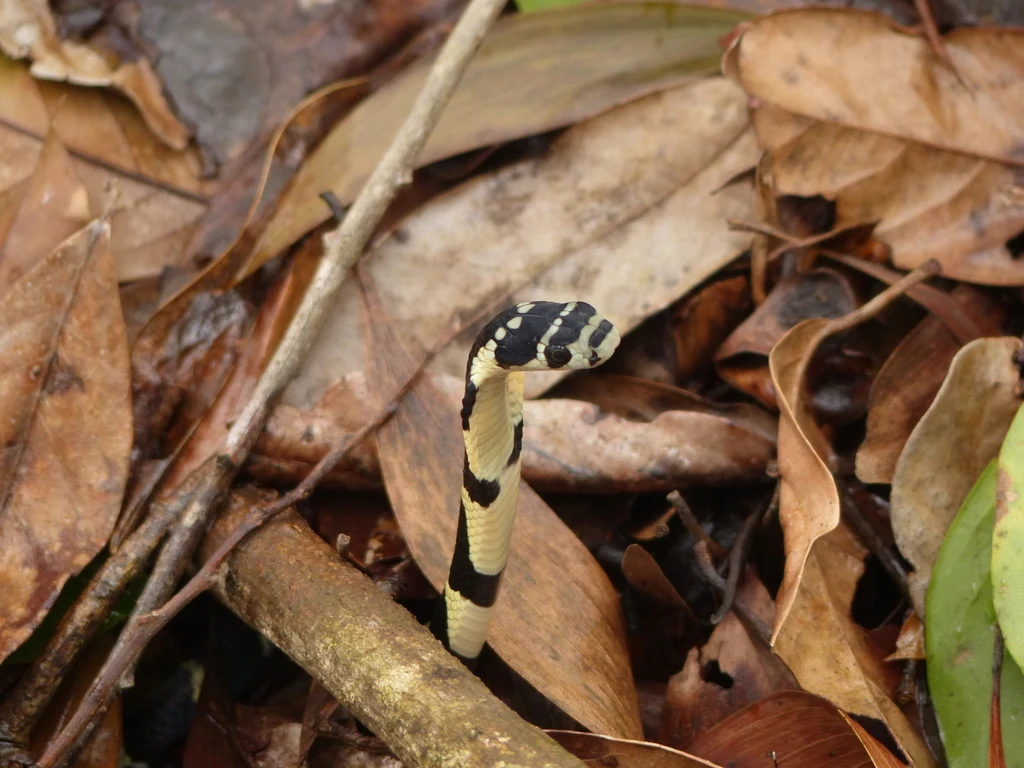
Venom & human effects
Classified as venomous in the cited review of Elapidae.
Published family-level classification with current exact membership verified. This is not a species-specific assay or a clinical severity assessment.
Jackson et al. (2016), Toxins 8:309, Introduction first paragraph explicitly characterises elapids as venomous; clinical effects are not inferred from this classification. Membership and complete species-specific Comment section: Ophiophagus kaalinga, accessed 2026-10-30.
These are editorial summaries of the linked evidence, not toxicity rankings or WHO antivenom-priority categories. Effects vary with the bite and patient. Non-venomous does not mean safe to handle.
The scientific identity
Reliable identification uses the published combination of scale characters, proportions and other diagnostic evidence. Colour or a photograph alone may not separate closely related species.
From observations & literature
No sourced size & measurements summary has yet been added to this account.
One radio-tracked adult male at Agumbe consumed 26 pit vipers during the 2009 observation period: 24 Malabar pit vipers and two hump-nosed pit vipers. This is a documented individual's diet, not a species-wide prey proportion.
Wild adult male M2, Agumbe, Western Ghats, India. The original paper used the former broad name O. hannah; the 2024 revision explicitly identifies this study's snakes as O. kaalinga.
Bhaisare et al. (2010), pp. 95 and 99, Results and Discussion; Das et al. (2024), p. 39 explicitly assigns this study to O. kaalinga.
The Agumbe tracking study recorded mainly daytime activity, with occasional movement after dark. The focal male searched crevices and vegetation while tongue-flicking, and climbed into the canopy while following prey trails.
Observations on radio-tracked snakes at Agumbe, especially adult male M2. Behaviour can vary with individual, season and locality; these records do not imply exclusive daytime activity.
Bhaisare et al. (2010), p. 99, activity observations and Results and Discussion; Das et al. (2024), p. 39 for explicit taxonomic reassignment.
Reproductive mode was not resolved in the checked treatment.
The species description characterizes it as a hill-forest snake, especially in rainforests around 500–900 m, with records from lower slopes to montane forest around 1,800 m.
Western Ghats account. The authors describe the elevation and habitat information as their unpublished observations; the values are approximate records rather than physiological limits.
Das et al. (2024), p. 30, Ophiophagus kaalinga, Distribution, final sentence.
India is explicitly listed in the checked individual taxonomic treatment. The national ZSI checklist independently lists Ophiophagus kaalinga. Regional evidence: Maharashtra, Goa; Karnataka, Kerala, Tamil Nadu. Named records do not imply continuous occurrence throughout a region.
[1][2]A reported observation is not necessarily the full ecological range of a species. Where reproduction is inferred in a source dataset, the account identifies that limitation.
One species · Across borders
Explore the recorded countries and islands. Select a highlighted area to see its distribution evidence.
Loading geographic boundaries…
Click a highlighted country to zoom in and explore its records.
Shading identifies recorded countries or named islands, not continuous habitat coverage. Uncoloured areas do not establish absence.
Natural Earth · 1:50m · public domain; Gibraltar: geoBoundaries. Small islands may lack an outline.
Explore the distribution
Select a highlighted area to see its status, island records and sources. Each country and island links to the same shared species collection.
Use “Worldwide records” to include distant introduced and uncertain records in the map view.
India is explicitly listed in the checked individual taxonomic treatment. The national ZSI checklist independently lists Ophiophagus kaalinga. Regional evidence: Maharashtra, Goa; Karnataka, Kerala, Tamil Nadu. Named records do not imply continuous occurrence throughout a region.
Western drylands & coast → · Maharashtra, Goa
Southern peninsula → · Karnataka, Kerala, Tamil Nadu
Locality source 1 ↗ Locality source 2 ↗Verified country records in this account: India. These are occurrence records, not continuous range polygons. Detailed locality evidence and taxonomic qualifications are documented below. [1][2]
The text retains the source’s geographic qualifications. The map shows countries with atlas occurrence records; it is not a complete global range model. A type locality is a nomenclatural reference, not the only place the species occurs.
Status & its meaning
No matching global assessment was verified for this account. This is an unresolved assessment link, not an IUCN “Not Evaluated” classification and not evidence that the species is secure.
Locality coverage in the atlas does not measure abundance, population trends or national legal protection.
Follow the evidence
Latest evidence added 2026-10-28. Taxonomic and distribution treatments may change.
The linked taxonomic treatment provides its original descriptions, revisions and bibliography. Observations from other countries are not relabelled as local field studies.