Hebius yangiLIU, WANG, HOU, DENG, ZHANG, WANG & RAO, 2026
Venom unknownNot yet assessed
China is explicitly recorded in the checked individual species treatment. Named regional records: Yunnan Province, Yunnan. These localities do not imply continuous occupation of the entire region.
FamilyColubridae
ReproductionReproductive mode was not resolved in the checked treatment
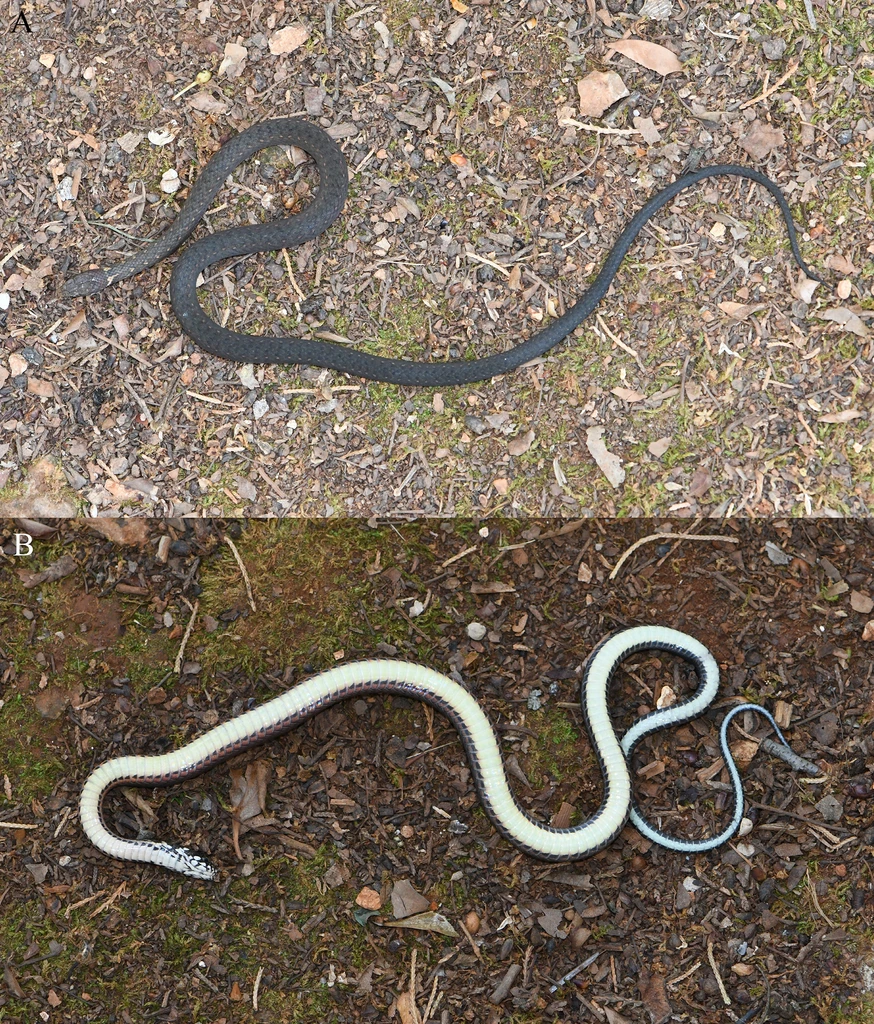
Hebius yangi. Holotype KIZ2025058 photographed in life, dorsal and ventral views. Isolated source photograph; no new occurrence record is inferred. Liu, Shuo; Wang, JiShan; Hou, Mian; Deng, Tao; Zhang, Chaowu; Wang, Mo; Rao, Dingqi · CC BY 4.0. Original publisher figure caption explicitly identifies the selected Figure2, complete frame as Hebius yangi. The published specimen/panel identification and image content were visually matched. Full source frame; resized if needed and converted to WebP. No object retouching or synthesis.
Venom & human effects
What is documented?
Venom unknownNot yet assessed
Venom status has not yet been established from the reviewed evidence for this account.
Missing evidence is not a non-venomous classification or a statement of low risk.
How to read these badges
Limited documented effects
The cited human cases reported limited effects. Sparse observations cannot exclude a severe reaction.
Medically significant effects
The cited human cases document clinically important injury or illness. This is not an upper limit on severity.
Potentially life-threatening
Species-specific clinical evidence documents life-threatening illness or deaths after bites. The account explains the affected patients and any uncertainty about the cause.
Clinical severity not established
Venom presence is documented, but the reviewed evidence does not establish a clinical tier. When human effects are reported under an unresolved historical species name, the badge and account say so explicitly.
Venom status uncertain
The reviewed sources are inconclusive or conflicting about venom presence. The account explains the uncertainty.
Venom status not assessed
The atlas lacks a reviewed venom-presence classification for this species.
These are editorial summaries of the linked evidence, not toxicity rankings or WHO antivenom-priority categories. Effects vary with the bite and patient. Non-venomous does not mean safe to handle.
The scientific identity
Taxonomy & recognition
Accepted name in this edition
Hebius yangi
Authority
LIU, WANG, HOU, DENG, ZHANG, WANG & RAO, 2026
Family
Colubridae
Type-locality statement
Xiajinchang Township, Malipo County, Wenshan Prefecture, Yunnan Province, China (23°11'7"N, 104°48'12"E; 1450 m a.s.l.).
Read the complete diagnosis
Reliable identification uses the published combination of scale characters, proportions and other diagnostic evidence. Colour or a photograph alone may not separate closely related species.
The adult male holotype measured 237 mm from snout to vent with a 118 mm tail (355 mm total); the adult male paratype measured 306 mm from snout to vent with a 143 mm tail (449 mm total).
The two intact type specimens, KIZ2025058 and KIZ2025175, from Malipo, Yunnan, China. These measurements do not establish female size or a species-wide adult-size range.
Study & evidence
Original description, Holotype and Paratype; Table 2; Methods limits morphometric measurements to the two intact specimens.
No sourced diet & feeding summary has yet been added to this account.
Activity & behaviour
One specimen in the original description was observed crossing a road during daylight; the other two were road-killed. Only the live encounter establishes activity, and the authors reported that further ecological information was unavailable.
Species-specific observations reported in the cited primary treatment. The accepted name exactly matches the atlas identity; no observations from historically confused species or congeners are transferred. Small samples and collection circumstances do not establish universal habitat preferences or activity patterns.
Reproductive mode was not resolved in the checked treatment.
Habitat & ecology
The collection road was bordered by evergreen broad-leaved forest and farmland, with no water body nearby. This describes the immediate surroundings of three records, not evidence that the species avoids aquatic habitats.
Species-specific observations reported in the cited primary treatment. The accepted name exactly matches the atlas identity; no observations from historically confused species or congeners are transferred. Small samples and collection circumstances do not establish universal habitat preferences or activity patterns.
China is explicitly recorded in the checked individual species treatment. Named regional records: Yunnan Province, Yunnan. These localities do not imply continuous occupation of the entire region.
A reported observation is not necessarily the full ecological range of a species. Where reproduction is inferred in a source dataset, the account identifies that limitation.
One species · Across borders
Global distribution
Explore the recorded countries and islands. Select a highlighted area to see its distribution evidence.
Recorded distributionN ↑
Loading geographic boundaries…
ListedIntroducedUncertain
Click a highlighted country to zoom in and explore its records.
Shading identifies recorded countries or named islands, not continuous habitat coverage. Uncoloured areas do not establish absence.
Select a highlighted area to see its status, island records and sources. Each country and island links to the same shared species collection.
Use “Worldwide records” to include distant introduced and uncertain records in the map view.
China · regional locality evidence
China is explicitly recorded in the checked individual species treatment. Named regional records: Yunnan Province, Yunnan. These localities do not imply continuous occupation of the entire region.
Verified country records in this account: China. Occurrence records are not continuous range polygons; locality and identity qualifications are documented below. [1]
The text retains the source’s geographic qualifications. The map shows countries with atlas occurrence records; it is not a complete global range model. A type locality is a nomenclatural reference, not the only place the species occurs.
Status & its meaning
Conservation
No matching global assessment was verified for this account. This is an unresolved assessment link, not an IUCN “Not Evaluated” classification and not evidence that the species is secure.
Locality coverage in the atlas does not measure abundance, population trends or national legal protection.
Follow the evidence
Sources & further reading
Latest evidence added 2026-10-28. Taxonomic and distribution treatments may change.
The linked taxonomic treatment provides its original descriptions, revisions and bibliography. Observations from other countries are not relabelled as local field studies.