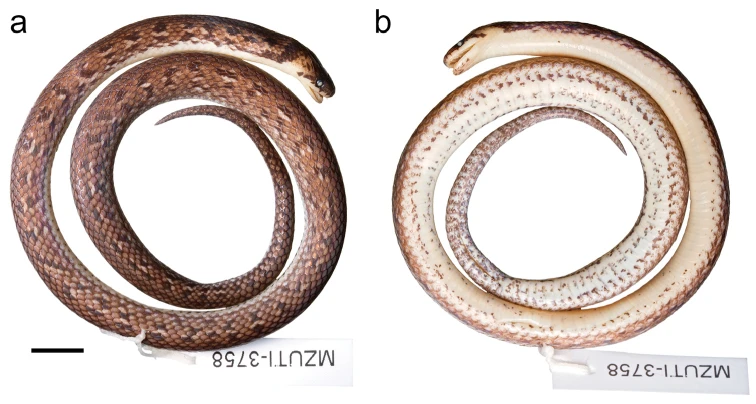
The two specimens described were moving through soil and roots at night in secondary evergreen lowland forest. The nearest natural waterbody was several hundred metres away, so no wetland category is inferred. Habitat categories do not create a new country or regional occurrence.
Atractus esepe holotype MZUTI 3758, dorsal and ventral views, original Figure 6 in Molecular phylogeny of Atractus (ZooKeys, 2017). Preserved museum specimen; colours may differ from life. Portrait only; no new occurrence or habitat inferred. Alejandro Arteaga, Konrad Mebert, Jorge H. Valencia, Diego F. Cisneros-Heredia, Nicolás Peñafiel, Carolina Reyes-Puig, José L. Vieira-Fernandes and Juan M. Guayasamin · CC BY 4.0. Exact type-specimen caption and original full figure reviewed. CC BY 4.0 in the article license. Figure obtained through the Europe PMC open-access supplementary-files API. Photographer attribution checked against caption and acknowledgements. Complete original photograph or figure converted to WebP; no crop, synthesis or retouching. Display crops may apply.
Venom & human effects
What is documented?
Non-venomous
Classified as non-venomous in the cited account of genus Atractus; this species’ membership of that genus is verified separately.
Explicit genus-level classification applied to an exact listed member, not a species-specific venom assay or human clinical study of Atractus esepe. The group statement does not transfer diet, body size, behaviour or medical severity. No human-harm tier is inferred.
Evidence & scope · checked 2026-10-29
Montes-Correa et al. (2017), First record of Atractus turikensis from the Colombian Perija highlands, Herpetological Bulletin 141:35–39, page35 Introduction opening paragraph explicitly characterises genus Atractus as non-venomous. Membership: exact-species taxonomic account Atractus esepe.
The cited human cases reported limited effects. Sparse observations cannot exclude a severe reaction.
Medically significant effects
The cited human cases document clinically important injury or illness. This is not an upper limit on severity.
Potentially life-threatening
Species-specific clinical evidence documents life-threatening illness or deaths after bites. The account explains the affected patients and any uncertainty about the cause.
Clinical severity not established
Venom presence is documented, but the reviewed evidence does not establish a clinical tier. When human effects are reported under an unresolved historical species name, the badge and account say so explicitly.
Venom status uncertain
The reviewed sources are inconclusive or conflicting about venom presence. The account explains the uncertainty.
Venom status not assessed
The atlas lacks a reviewed venom-presence classification for this species.
These are editorial summaries of the linked evidence, not toxicity rankings or WHO antivenom-priority categories. Effects vary with the bite and patient. Non-venomous does not mean safe to handle.
Reliable identification uses the published combination of scale characters, proportions and other diagnostic evidence. Colour or a photograph alone may not separate closely related species.
The male holotype (MZUTI 3758) measured 232 mm from snout to vent with a 53 mm tail; the female paratype (MZUTI 3759) measured 241 mm from snout to vent with a 34 mm tail.
Two Ecuadorian type specimens. Individual values do not establish sexual size dimorphism or an adult-size range. The original species concept is retained in the 2022 reassessment.
Study & evidence
Arteaga et al. (2017), Table 6, A. esepe rows and type accounts; Methods defines TL as tail length.
No sourced diet & feeding summary has yet been added to this account.
Activity & behaviour
The two specimens discussed in the original description were actively foraging among soil and roots in secondary evergreen lowland forest at about 20:00. Both were at least 400 m from the nearest natural water body. The observation does not identify the prey they were seeking.
Species-specific observations reported in the cited primary treatment. The accepted name exactly matches the atlas identity; no observations from historically confused species or congeners are transferred. Small samples and collection circumstances do not establish universal habitat preferences or activity patterns.
Study & evidence
Atractus esepe species treatment, Natural history..
The two specimens described were moving through soil and roots at night in secondary evergreen lowland forest. The nearest natural waterbody was several hundred metres away, so no wetland category is inferred. Habitat categories do not create a new country or regional occurrence.
A reported observation is not necessarily the full ecological range of a species. Where reproduction is inferred in a source dataset, the account identifies that limitation.
One species · Across borders
Global distribution
Explore the recorded countries and islands. Select a highlighted area to see its distribution evidence.
Recorded distributionN ↑
Loading geographic boundaries…
ListedIntroducedUncertain
Click a highlighted country to zoom in and explore its records.
Shading identifies recorded countries or named islands, not continuous habitat coverage. Uncoloured areas do not establish absence.
Select a highlighted area to see its status, island records and sources. Each country and island links to the same shared species collection.
Use “Worldwide records” to include distant introduced and uncertain records in the map view.
Ecuador · regional locality evidence
The checked taxonomic distribution account explicitly lists Ecuador. Country-level evidence does not establish continuous occupancy or a complete national inventory.
Country entries supported by this Americas review: Ecuador. These are reviewed atlas entries, not a complete global distribution. [1]
The text retains the source’s geographic qualifications. The map shows countries with atlas occurrence records; it is not a complete global range model. A type locality is a nomenclatural reference, not the only place the species occurs.
Status & its meaning
Conservation
No matching global assessment was verified for this account. This is an unresolved assessment link, not an IUCN “Not Evaluated” classification and not evidence that the species is secure.
Locality coverage in the atlas does not measure abundance, population trends or national legal protection.
Follow the evidence
Sources & further reading
Latest evidence added 2026-10-19. Taxonomic and distribution treatments may change.
The linked taxonomic treatment provides its original descriptions, revisions and bibliography. Observations from other countries are not relabelled as local field studies.