Size & measurements
No sourced size & measurements summary has yet been added to this account.
Xenodermidae · Species account
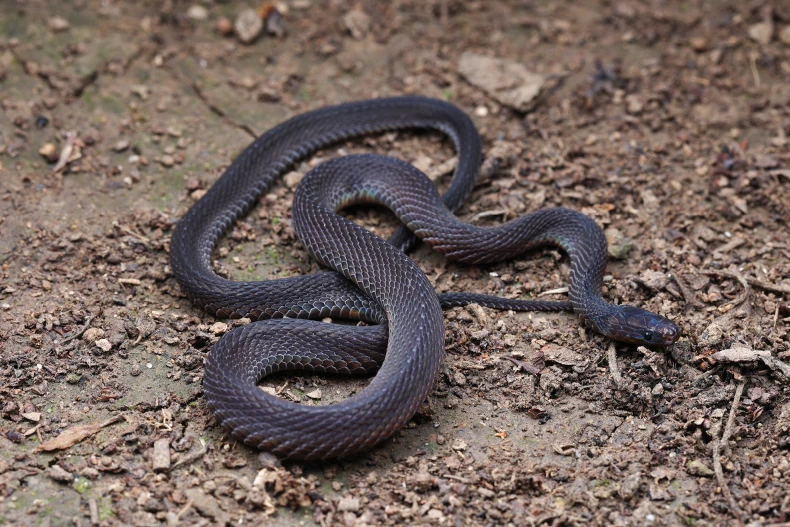
Achalinus sheniMA, XU, QI, WANG, TANG, HUANG & JIANG, 2023
Non-venomousChina: the reported sites lie at 350–410 m in a landscape whose native vegetation is subtropical evergreen broadleaf forest. One collection site was largely surrounded by planted Cryptomeria conifers. This records both native vegetation context and a modified collection setting.
Venom & human effects
Classified as non-venomous in the cited account of genus Achalinus; this species’ membership is verified separately.
Explicit group-level classification applied to an exact listed member, not a species-specific venom assay or human clinical study of Achalinus sheni. The group statement does not transfer diet, body size, behaviour or medical severity. No human-harm tier is inferred.
Ma et al. (2023), Discovery of a new cryptic Achalinus species from Hunan, ZooKeys 1181:9–27, Introduction opening paragraph explicitly characterises genus Achalinus as non-venomous. Membership: exact-species taxonomic account Achalinus sheni.
These are editorial summaries of the linked evidence, not toxicity rankings or WHO antivenom-priority categories. Effects vary with the bite and patient. Non-venomous does not mean safe to handle.
The scientific identity
Reliable identification uses the published combination of scale characters, proportions and other diagnostic evidence. Colour or a photograph alone may not separate closely related species.
From observations & literature
No sourced size & measurements summary has yet been added to this account.
Dissection of specimen LFR2023009 revealed undigested earthworms in its intestine.
A direct intestinal-content record from the Hunan study. It establishes consumption of earthworms; the authors’ suggestion that worms form the main wild diet remains untested by this single observation.
Xu et al. (2024), First report of albinism for Achalinus sheni, with extended diagnosis of the species; Natural history paragraph, specimen LFR2023009.
The Hunan treatment reports activity from March to October, with a peak in early summer. Individuals usually remained under rocks, decaying wood or fallen leaves; surface encounters on mountain roads were reported after rain or on humid nights. These observations describe the studied populations, not a proven range-wide seasonal schedule.
Evidence is limited to the species, population and observation context named in the summary. Resting is distinguished from active movement; habitat use is not an exclusive preference. Geographic records, model estimates and field observations are not extrapolated across unstudied populations.
Reproductive mode was not resolved in the checked treatment.
China: the reported sites lie at 350–410 m in a landscape whose native vegetation is subtropical evergreen broadleaf forest. One collection site was largely surrounded by planted Cryptomeria conifers. This records both native vegetation context and a modified collection setting.
[3]China is explicitly recorded in the checked individual species treatment. The accepted identity is also represented in the 2025 checklist; regional inclusion here is based on explicit locality evidence, not the checklist’s broader geographical scope. Named regional records: Hunan Province, Hunan. These localities do not imply continuous occupation of the entire region.
[1][2]China: The original description documents Lianyuan and Nanyue in Hunan. It does not establish occurrence throughout the surrounding province.
[4]A reported observation is not necessarily the full ecological range of a species. Where reproduction is inferred in a source dataset, the account identifies that limitation.
One species · Across borders
Explore the recorded countries and islands. Select a highlighted area to see its distribution evidence.
Loading geographic boundaries…
Click a highlighted country to zoom in and explore its records.
Shading identifies recorded countries or named islands, not continuous habitat coverage. Uncoloured areas do not establish absence.
Natural Earth · 1:50m · public domain; Gibraltar: geoBoundaries. Small islands may lack an outline.
Explore the distribution
Select a highlighted area to see its status, island records and sources. Each country and island links to the same shared species collection.
Use “Worldwide records” to include distant introduced and uncertain records in the map view.
China is explicitly recorded in the checked individual species treatment. The accepted identity is also represented in the 2025 checklist; regional inclusion here is based on explicit locality evidence, not the checklist’s broader geographical scope. Named regional records: Hunan Province, Hunan. These localities do not imply continuous occupation of the entire region. China: The original description documents Lianyuan and Nanyue in Hunan. It does not establish occurrence throughout the surrounding province.
Central river basins & mountains → · Hunan Province, Hunan, Lianyuan City, Hunan, Nanyue District, Hunan
Locality source 1 ↗ Locality source 2 ↗ Locality source 3 ↗Verified country records in this account: China. Occurrence records are not continuous range polygons; locality and identity qualifications are documented below. [1][2]
The text retains the source’s geographic qualifications. The map shows countries with atlas occurrence records; it is not a complete global range model. A type locality is a nomenclatural reference, not the only place the species occurs.
Status & its meaning
No matching global assessment was verified for this account. This is an unresolved assessment link, not an IUCN “Not Evaluated” classification and not evidence that the species is secure.
Locality coverage in the atlas does not measure abundance, population trends or national legal protection.
Follow the evidence
Latest evidence added 2026-10-11. Taxonomic and distribution treatments may change.
The linked taxonomic treatment provides its original descriptions, revisions and bibliography. Observations from other countries are not relabelled as local field studies.