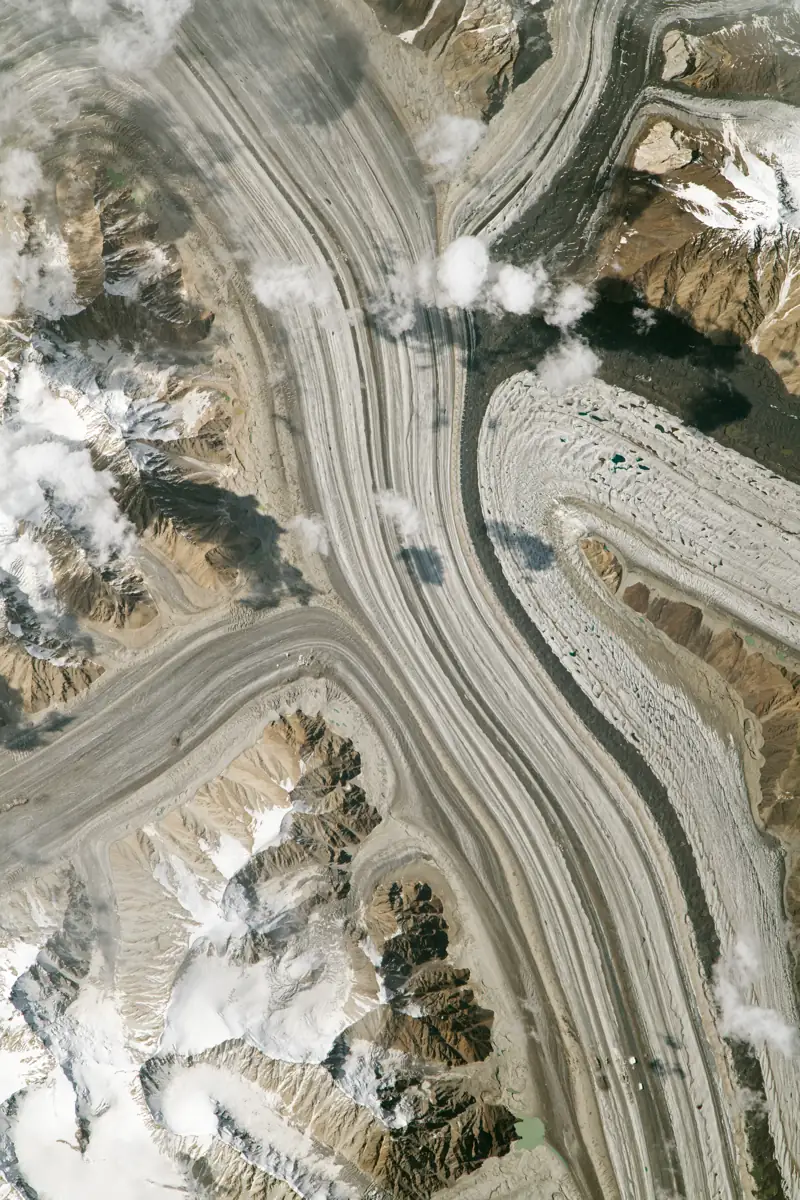
Siachen glacier and tributary ice photographed from the International Space Station on 15 August 2023 (ISS069-E-60266). Historical landscape view, not a snake observation.

Siachen Glacier · Habitat field guide

Glacier & moraine landscapes

Read exposed ice, debris-covered margins and meltwater as separate parts of a glacier system. No snake habitat association is inferred.

Siachen glacier and tributary ice photographed from the International Space Station on 15 August 2023 (ISS069-E-60266). Historical landscape view, not a snake observation.

Photograph: NASA / ISS Expedition 69 crew; JSC Earth Science and Remote Sensing Unit · Image source · NASA educational and informational use. Cropped to fill the hero; darkened for text legibility.

Understanding the environment

A sense of the habitat.

Read exposed ice, debris-covered margins and meltwater as separate parts of a glacier system. No snake habitat association is inferred.

Landscape
High-mountain ice and rock
Map date
9 November 2006
Biological evidence
Glacier-specific snake records unresolved

Explore the structure · Tributary ice → trunk → debris-covered margins

Read the glacier surface

Select a zone to see what changes.

Converging ice

Tributary junctions

Follow where ice streams merge.

A named glacier is a geographic reference, not an animal record.

Conceptual reading sequence, not a measured transect, route or species range.

Sources: NASA Earth Observatory · Siachen Glacier (2024) · Agarwal et al. (2017) · Area and mass changes of Siachen Glacier

Field notes · 01

Ice with a visible history

The 2023 orbital image shows tributary junctions, medial moraines and small surface-water features. A photograph records one moment; it does not measure today’s glacier extent.

Sources: NASA Earth Observatory · Siachen Glacier (2024)

Field notes · 02

Debris does not mean ice-free ground

Agarwal and colleagues used several satellite datasets to distinguish exposed and debris-covered ice. Their historical measurements found substantial spatial variation; one whole-glacier trend cannot describe every margin.

Sources: Agarwal et al. (2017) · Area and mass changes of Siachen Glacier

Field notes · 03

Where the water goes

Meltwater leaving the glacier enters the Nubra drainage, which connects to the Indus system. A downstream valley locality remains a different place from the glacier itself.

Sources: NASA Earth Observatory · Siachen Glacier (2006)

Pressures on Siachen Glacier’s habitats

What is at risk?

What helps this habitat

Retain observation dates and mapping uncertainty. Any future snake record needs a verifiable locality, identification and source before it is added.

The connected collection

Snakes with habitat evidence.

These 0 species have supported country occurrence and an explicit habitat association in the shared account. The association may come from elsewhere in their range. This is not a complete local habitat inventory; the places above are landscape examples, not asserted collecting sites.

No species-level association has yet been resolved for this habitat in the collection. That does not mean snakes are absent.

0 species · showing 0

No matching locality records.

Try another name or clear the filters. Absence from a regional list does not establish absence in nature.

All 0 species in the country collection →

Read further

Evidence & sources.

Guide reviewed 12 October 2026. Source dates and geographic scope matter; landscape photographs do not establish species occurrence.

  1. NASA Earth Observatory · Siachen Glacier (2024)

    ISS image taken 15 August 2023: tributary ice, moraines and surface water; landscape context only.

  2. NASA Earth Observatory · Siachen Glacier (2006)

    Landsat image taken 18 May 2001; glacier junctions and Nubra drainage.

  3. Agarwal et al. (2017) · Area and mass changes of Siachen Glacier

    Remote-sensing study of historical area, elevation and mass changes; not a biological survey.

  4. GLIMS / ICIMOD · Siachen analysis 163138

    Glacier G077129E35401N, source date 9 November 2006; simplified for geographic navigation.

Continue through Siachen Glacier

Explore another habitat.