Saint Martin · Habitat field guide
Ponds and mangrove margins
The nature reserve recognizes mangroves, ponds and coastal dry forest as distinct ecosystems. Mangrove margins filter and retain land-derived sediment between terrestrial and marine environments.
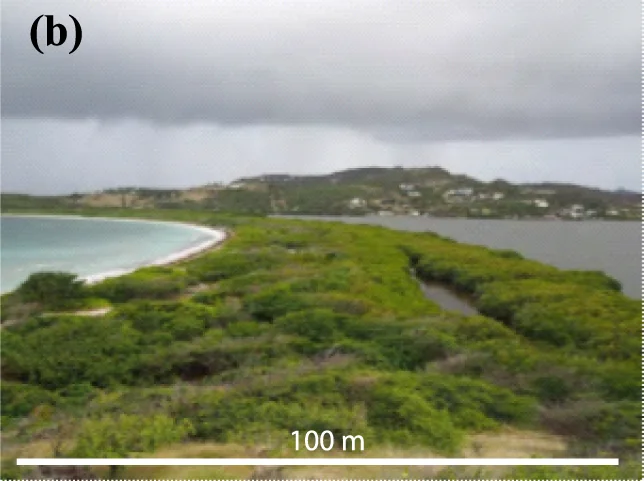
Mangroves and associated coastal vegetation at Étang aux Poissons, French Saint-Martin, photographed in 2017 before Hurricane Irma. Historical view from Walcker et al. (2019), Figure 2(b); it does not depict current condition.
Understanding the environment
A sense of the habitat.
The nature reserve recognizes mangroves, ponds and coastal dry forest as distinct ecosystems. Mangrove margins filter and retain land-derived sediment between terrestrial and marine environments.
- Named setting
- French Saint-Martin coastal ponds
- Evidence scale
- Habitat context; local snake occupancy requires its own record.
Explore the structure · Compare the named landscape components.
Ponds and mangrove margins
Select a zone to see what changes.
Coastal water
Pond
Keep the pond’s setting distinct from a river or an inland lake.
Use the source to retain the named place and observation scale.
Conceptual reading guide, not a measured transect or species range.
Field notes · 01
Read the landscape
The nature reserve recognizes mangroves, ponds and coastal dry forest as distinct ecosystems. Mangrove margins filter and retain land-derived sediment between terrestrial and marine environments.
Pressures on Saint Martin’s habitats
What is at risk?
A site-specific assessment of pressures has not yet been extracted for this guide. The landscape sources below provide context; they do not establish a current threat level for each snake species.
What helps this habitat
Retain the source date and distinguish habitat description from species occurrence. Use official local guidance for access.
The connected collection
Snakes with habitat evidence.
These 0 species have supported country occurrence and an explicit habitat association in the shared account. The association may come from elsewhere in their range. This is not a complete local habitat inventory; the places above are landscape examples, not asserted collecting sites.
No species-level association has yet been resolved for this habitat in the collection. That does not mean snakes are absent.
0 species · showing 0
No matching locality records.
Try another name or clear the filters. Absence from a regional list does not establish absence in nature.
Read further
Evidence & sources.
Guide reviewed 2026-10-28. Source dates and geographic scope matter; landscape photographs do not establish species occurrence.
- Saint-Martin reserve · Natural habitats
Dated source for the geography or biological evidence described here; checked 28 October 2026.
Continue through Saint Martin