Monaco · The country atlas
Monaco
Limestone cliffs and coastal vegetation remain within a predominantly urban Mediterranean setting, alongside managed green spaces. Explore the regional guides and country-scoped species records below.
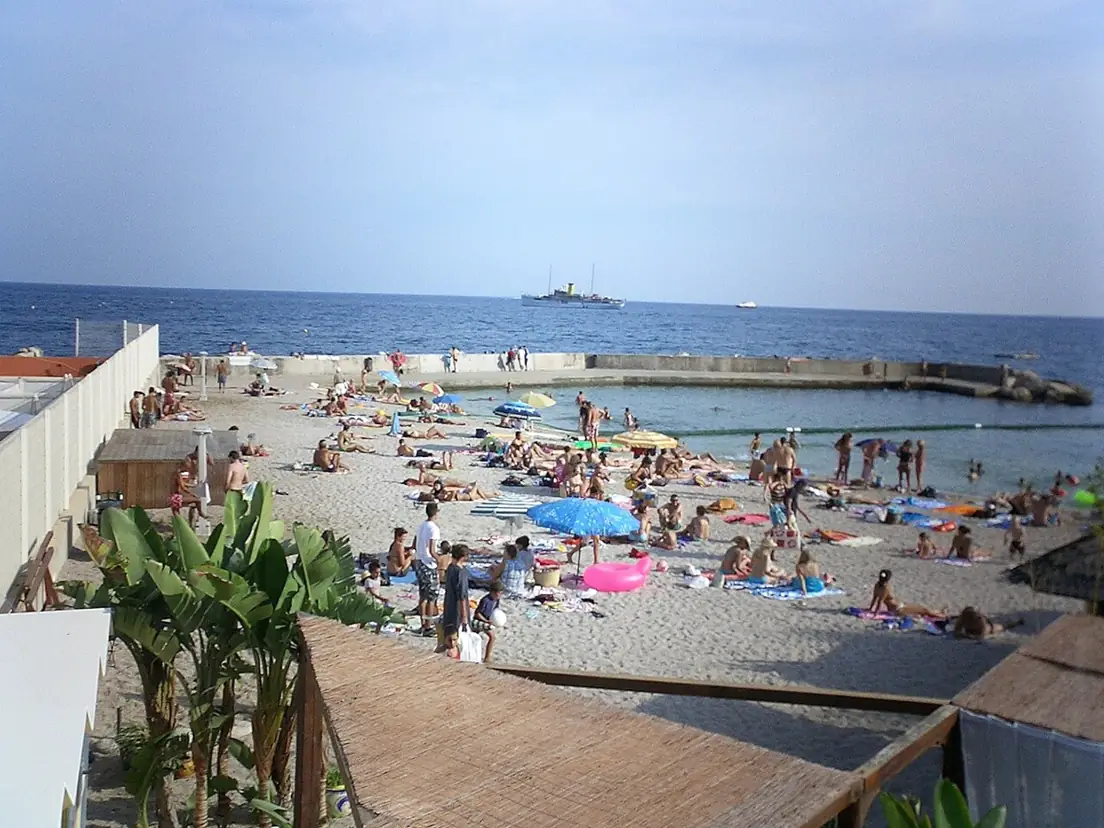
Larvotto's developed bathing beach, Monaco. The image does not show or measure the protected underwater seagrass.
Geography & biotopes
Discover Monaco.
Limestone cliffs and coastal vegetation remain within a predominantly urban Mediterranean setting, alongside managed green spaces. Explore the regional guides and country-scoped species records below.
Regional groups retain the credited administrative snapshot. They are navigation areas, not ecological boundaries or claims of snake occurrence throughout each area.
Habitats & living landscapes
Explore the living
landscapes.
Explore 1 guides to the environments, places and conservation pressures that shape this country. Each guide connects to the regional map and shared species accounts.
Landscape photographs & credits
Larvotto's developed bathing beach, Monaco. The image does not show or measure the protected underwater seagrass. — kajikawa. Original photograph · CC BY 3.0. Cropped for the cards; photographs do not establish snake occurrence.

The species catalogue
Meet the snakes of Monaco.
Search scientific names, historical names, common names and families. Every card opens one shared account across its documented countries.
The checked national report does not establish a current snake inventory. An empty list here is a research gap, not proof of snake absence. Monaco: environment statistics (2018), biodiversity section ↗
No supported country records have been extracted for this selection. This is a research gap, not evidence that snakes are absent.
0 species · showing 0
No matching locality records.
Try another name or clear the filters. Absence from a regional list does not establish absence in nature.
The research library
Sources & the checklist.
This edition lists 0 species with supported country records from checked taxonomic treatments and cited field studies. It is not a claim of a complete national inventory. Each account retains its source and check date; individual evidence entries retain their own review dates.
Independent checklist comparison · 2026-10-11
The checked national report does not establish a current snake inventory. An empty list here is a research gap, not proof of snake absence.
Monaco: environment statistics (2018), biodiversity section ↗
Review still open
How the map and counts work
Search results were checked against distribution text and taxonomic qualifications. A geographic name alone does not establish a political country: New Guinea, the Solomon archipelago and Micronesia span more than one country or territory. Introduced and unresolved records require separate interpretation.
Place counts require explicit named localities, including valid type localities. Counts can overlap where sources name multiple places. Regional maps group historical boundary snapshots for navigation, while island outlines use Natural Earth; neither is a species range or an observation map. Small islands can be below the outline dataset’s resolution, so geographic reference markers and the directory remain available.
© OpenStreetMap contributors; OpenStreetMap, Wambacher; geoBoundaries gbOpen ADM1; 2017; Open Data Commons Open Database License 1.0. Generalised navigation outlines, not species ranges. Map provenance →
- Boundary provenance and regional grouping ↗
- Convention on Biological Diversity - Monaco profile ↗
- The Reptile Database
Individual treatments and locality evidence are linked from each species account.
- Meiri (2024): SquamBase 1.0
Species-level literature measurements and ecological traits. Exact-name matches only; imputed or ambiguous fields are omitted. These summaries are not local observations.
- Natural Earth: public-domain geographic data